Helmholtz at HANNOVER MESSE
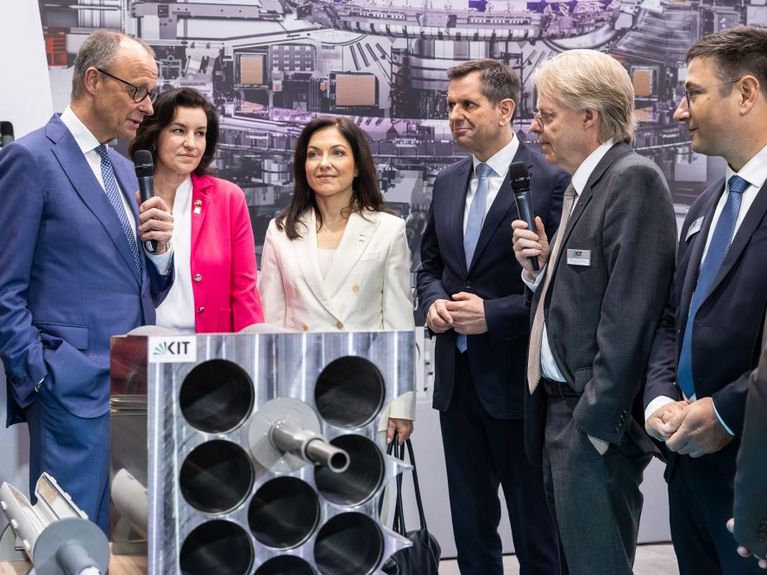
German Chancellor Friedrich Merz, Federal Minister of Research, Technology and Space Dorothee Bär, and Federal Minister for Economic Affairs and Energy Katharina Reiche at the KIT booth. Photo: KIT
At HANNOVER MESSE, Helmholtz demonstrates how research is driving advances in future technologies, from robotics and green hydrogen to quantum computing and printed solar cells.
At first glance, the exhibits seem unremarkable: At HANNOVER MESSE, the Karlsruhe Institute of Technology (KIT) is presenting steel blocks with deep boreholes. Yet these components are highly complex—and central to the future energy supply. At the heart of fusion reactors, these so-called breeding blankets will generate fuel. KIT is a global leader in their development. During his tour of HANNOVER MESSE, German Chancellor Friedrich Merz also inspected a prototype. The German Federal Government provides substantial funding for fusion research to build the world’s first fusion reactor in Germany. According to the Chancellor, KIT’s research is essential to achieving this goal.
Examples like these show how Helmholtz uses cutting-edge research to advance numerous future technologies while working closely with industry partners. Helmholtz therefore has a strong presence at HANNOVER MESSE, the world’s leading industrial trade fair. The Helmholtz research centers showcase the full breadth of their expertise. They present innovative devices, simulations, and materials in fields ranging from secure communications and drug discovery to high-performance battery research for the energy transition.
KIT, for example, is showcasing industrial robots designed for sensitive collaboration and enhanced precision through camera-based systems. KIT is also demonstrating a new ceramic printing technique at HANNOVER MESSE that combines two different ceramic materials into a single component during printing. This results in high-precision hybrid ceramics with locally varying properties, such as a hard outer layer and a porous core. This process is particularly relevant to industries that rely on customized, high-performance components, including mechanical engineering, aerospace, and medical technology.

Karsten Wildberger, Federal Minister for Digital Transformation and Government Modernisation, and Astrid Lambrecht, Chair of the Board of Directors of Forschungszentrum Jülich. Photo: FZJ
At HANNOVER MESSE, Forschungszentrum Jülich is showcasing its research with a particular focus on AI. Visitors can explore this research area using the CUPITER demonstrator. The exhibit is complemented by three thematic areas, including one dedicated to future computing. Forschungszentrum Jülich operates some of the world’s most powerful computers. These computers enable researchers to process large volumes of data and conduct highly detailed simulations in fields such as climate research, fluid dynamics, and molecular dynamics. Using this computing power, the research center also develops and trains AI models, providing Europe with alternatives to existing commercial offerings. A second focus of the exhibition is energy. Researchers from Jülich are presenting printed solar cells that are more cost-effective and environmentally friendly than conventional solar cells, as well as battery storage systems that exceed previous performance limits.

DLR booth at HANNOVER MESSE. Photo: DLR
The German Aerospace Center (DLR) conducts research in aerospace, energy, transport, security and defense. The exhibits include intelligent robotic systems that use cameras to systematically inspect surfaces and AI to autonomously identify damage, such as cracks in an aircraft fuselage. DLR is also presenting H2MARE in Hanover, an innovative process that enables hydrogen to be produced directly at offshore wind turbines. To make green hydrogen production even more environmentally friendly, DLR is showcasing a prototype of its 100-kilowatt stack at the trade fair. Such stacks are essential for electrolysis. DLR’s prototype is made from sustainable materials and contains no critical raw materials or so-called “forever chemicals” such as PFAS. The prototype emerged from HyScale, an EU project with significant contributions from DLR. The research center is also active in quantum computing. At HANNOVER MESSE, DLR is presenting its DLR Quantum Computing Initiative (DLR QCI). The initiative gives both large companies and small and medium-sized enterprises access to quantum computing.
The Helmholtz research centers also provide their spin-offs with a platform at HANNOVER MESSE to engage with industry. One example is Photreon, a KIT start-up, that aims to advance the hydrogen economy. To this end, the founders have developed a panel that produces hydrogen directly from sunlight and water, eliminating the need for electrolyzers and an external electricity supply. In the future, these panels could be used wherever hydrogen is too expensive or logistically difficult to supply, for example, by small and medium-sized enterprises seeking to meet their hydrogen demand directly on-site in the specialty chemicals, food-processing, and metalworking industries. The panels are also suitable for large-scale solar projects in regions with high levels of solar irradiance. A patent application for the panels has already been filed.


Readers comments