Portrait
The Disorder of Life
Picture: K. Boes/MPI-CBG
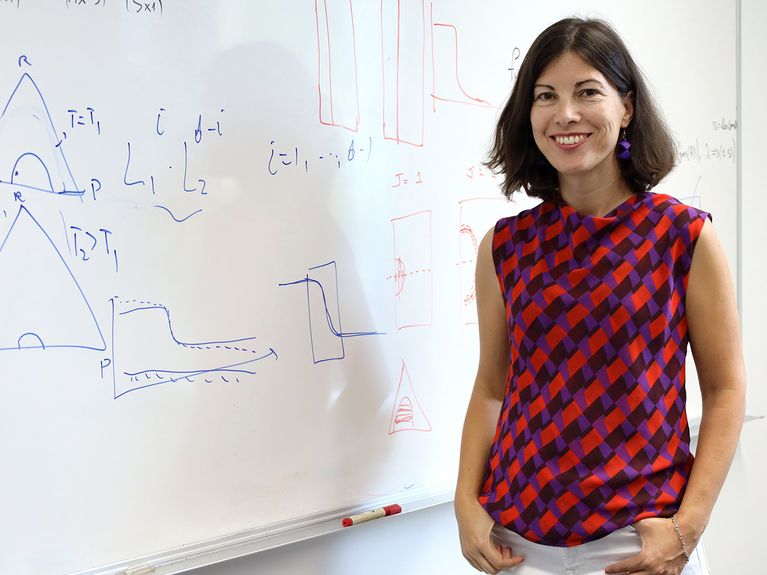
Chemist Ágnes Tóth-Petróczy studies disordered proteins. It’s clear that these proteins play a role in the development of diseases – and she and her research group are now working to uncover exactly what happens in the body during this process.
Cycling is the only sport Ágnes Tóth-Petróczy does besides her research: her two younger children ride in the trailer, while the two older ones already ride on their own – “I deliberately didn’t buy an e-bike,” she says, “cycling is my workout!” Her rides take her through Dresden, sometimes along the Elbe River. The chemist conducts her research at CASUS: the Center for Advanced Systems Understanding (CASUS) based in Görlitz and part of the Helmholtz Center Dresden-Rossendorf (HZDR).
“My mother already suspected I’d become a researcher when I was still very young,” says Ágnes Tóth-Petróczy. Her curiosity must have been immense, and at first it was the stars – astronomy – that drew her in – “but then it got worse,” she says with a laugh: nature and biology, then molecules, and finally proteins. Without realizing it, she was thus drawing closer to the major topic that still occupies her today: The question of how proteins contribute to the development of diseases is what drives her, and from her original field of study, chemistry, she has ventured further and further into related disciplines – biochemistry, bioinformatics, and clinical genetics.
When she enrolled at the university in Budapest, about an hour away from her hometown of Esztergom, she arrived at exactly the right time: A few years earlier, around the year 2000, the first scientific papers dealing with so-called “intrinsically disordered proteins” had been published. One of the groundbreaking works on this topic came from Peter Tompa and, later, Monika Fuxreiter at her alma mater. “There had already been indications of these intrinsically disordered proteins, but no function was attributed to them,” explains Ágnes Tóth-Petróczy. Today, they are considered one of the most exciting discoveries in modern molecular biology – and there is ample evidence that they play a role in the development of various diseases, ranging from cancer to neurodegenerative disorders.
The term “disordered” is often misleading: These proteins are not randomly structured or chaotically arranged – on the contrary, their blueprint is just as clear-cut as that of classical proteins. The key difference is that they do not have a fixed structure. The strict systematics governing the structure of classical proteins do not apply in their case – which is presumably why researchers have considered them, at best, insignificant for decades. They are constantly changing, and these changes appear to be part of complex molecular processes that are not yet understood. In many cases, it was even assumed that there must be an error in the experiment when they became visible. Today we know that these disordered proteins account for about 30 percent of human proteins. They are components of signaling pathways, they help regulate gene expression, and they serve as molecular switches. Deciphering their mode of action in detail is one of the major challenges that Ágnes Tóth-Petróczy and her team have set out to tackle.
As she was about to begin her doctoral studies, she moved from Budapest to Israel: Dan Tawfik, a renowned expert in molecular evolution, was conducting research at the Weizmann Institute there. “I owe him an immense amount,” says Tóth-Petróczy of her mentor, who died in an accident a few years ago: “Among other things, he taught me to enjoy the daily process of research.” In Israel, she also met her future husband; he is also a chemist and had come to Israel from Germany for a research fellowship. “Our daughter was born there,” says Ágnes Tóth-Petróczy – and soon after, the young family moved on to the U.S. to Harvard Medical School, where she conducted research on the team of Debbie Marks, a well-known systems biologist and AI researcher.
First as a doctoral student and then as a postdoc, the researcher realized that a bizarre coincidence from her time in Budapest was actually helping her: At the university in Budapest, the X-ray crystallography machines – which offer one of the most important ways to study the 3-D structure of proteins – were broken – “and they stayed broken throughout my entire time as a student!” Ágnes Tóth-Petróczy therefore quickly switched to using computer models to conduct her analyses. “Theoretical chemistry and simulations were one of the university’s strongest fields, and that’s where I discovered my passion for coding,” she says. Today, she notes, the field of research is more exciting than ever before because AI is enabling progress at an unprecedented pace. That is precisely CASUS’s specialty: the center develops algorithms and models, with a particular focus on AI. CASUS brings together leading scientists from different disciplines at a single institute in Görlitz to work in interdisciplinary teams and develop visionary ideas for tackling the complex challenges of the future using digital methods.
When Ágnes Tóth-Petróczy rides her bike through Dresden today, she knows that moving back to Europe from the U.S. was the right decision. She made that decision in 2018, when Tóth-Petróczy took over a Max Planck research group in Dresden. “My husband and I both wanted to return to Europe because our families are here,” she recalls. Her own family also grew in Dresden: her three sons were born there – the children who are now cycling through Dresden with her.
And from a research perspective, too, it was a groundbreaking decision. “Dresden is the center for research on biomolecular condensates,” says Ágnes Tóth-Petróczy. This is a field of research closely linked to disordered proteins: These proteins coordinate the formation of biomolecular condensates – small droplets within the cell in which proteins and other molecules are concentrated. These structures play a major role in the complex molecular processes of the cell. Researchers hope they will offer the possibility of intervening in the development of diseases.
Ágnes Tóth-Petróczy has thus returned to a point at the very beginning of her career: When she was about to take her high school graduation exams, she wavered between the fields of chemistry and medicine. At CASUS in Görlitz, she can now combine both.
CASUS – the Center for Advanced Systems Understanding – is unique in Germany as a center for digital interdisciplinary systems research and aims to take a leading international position in this emerging field of research.
Digital interdisciplinary systems research explores and develops the latest and most innovative methods from mathematics, modeling, simulation, data science, and computer science to address questions from such diverse areas of systems research as Earth system science, systems biology, digital health, and materials science.
CASUS brings together the best scientists from these fields at a single institute to develop visionary ideas in interdisciplinary teams on how to master the complex challenges of the future using digital methods.


Readers comments