Geothermal Energy
The Heat Transition from Below
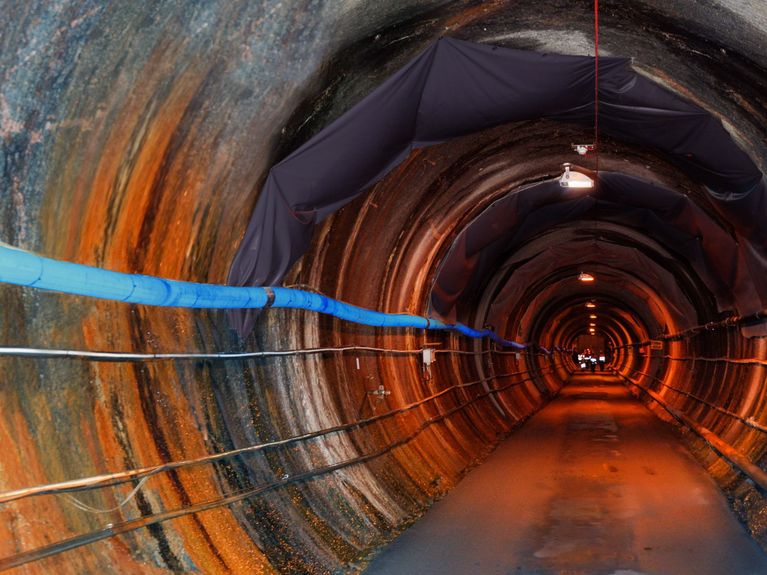
Image KIT
Geothermal energy could meet a quarter of our heat demand. In the long term, the potential is even greater. Researchers are developing practical solutions to make this possible.
To avoid further accelerating climate change, Germany aims to achieve net-zero greenhouse gas emissions by 2045 and negative emissions after 2050. This also means changing how we generate and use heat. After all, the heat sector accounts for more than half of Germany’s energy demand. To meet this demand, we can tap into energy resources beneath our feet. With every kilometre of depth, the temperature increases by an average of 30 degrees Celsius. This heat is continuously and reliably available.
In the future, geothermal energy could meet a significant share of Germany’s heat demand. With existing hydrothermal deep geothermal technologies—and with the necessary investments—a quarter of Germany’s heat demand could be met by the decade after next. The principle is simple: water is injected into the subsurface, where it heats up before being pumped back to the surface. With further technological development, an even larger share of heat demand could be met sustainably. One option is seasonal deep thermal storage, in which heat can be stored for months with only minor losses, allowing surplus summer heat to be used for winter heating. Another option is to tap the geothermal potential of crystalline bedrock, which is found, for example, in the Black Forest and the Eifel region. Its inherently low permeability must be increased through stimulation measures to tap a significant share of Germany’s geothermal potential. The Helmholtz Centres KIT, GFZ and UFZ are working to develop these additional, strategically important resources—not least through large-scale research infrastructures and scientific support for pilot projects.
The Roadmap for Deep Geothermal Energy, a strategy paper jointly developed by the Fraunhofer-Gesellschaft and the Helmholtz Association, recommends meeting at least 100 terawatt-hours per year (TWh/a) of heat demand by 2030 using hydrothermal deep geothermal energy—that is, by exploiting hot-water resources in the deeper subsurface. By 2040, the target should be increased to 300 TWh/a. This corresponds to 25 percent of Germany’s total heat demand, with demand coming from homeowners and municipalities as well as industrial facilities.
Generating Heat and Purifying Water
Shallow geothermal systems have long been ready for widespread deployment, particularly for individual buildings. Since geothermal energy generally requires little space, it can also provide localised heat supply in densely populated urban areas where competition for land is high. “However, this presents a greater technical challenge,” says Olaf Kolditz, head of the Department of Environmental Informatics at the Helmholtz Centre for Environmental Research (UFZ) in Leipzig and a professor at TU Dresden. “To use the available resources economically and ecologically, we need to optimise the operation of complex systems comprising borehole heat exchangers and ground-source heat pumps, particularly for larger systems—for example, at district level.” How can the individual components of a complex district-scale system best be dimensioned and coordinated to ensure efficient and sustainable operation? Together with its project partners—the Leipzig University of Applied Sciences (HTWK) and the Weishaupt Group, a leading manufacturer of heat pumps—Kolditz’s team has developed a decision-support tool for this purpose. The EASyQuart project, funded by the Federal Ministry of Education and Research, supports planners seeking to heat or cool a campus or urban district using shallow geothermal resources.
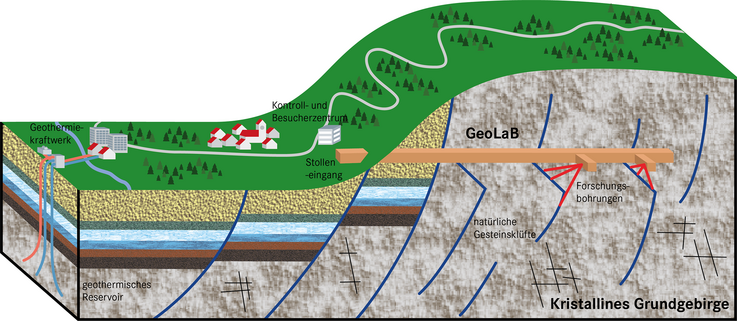
In the GeoLaB underground laboratory, researchers can directly observe processes associated with deep geothermal energy. Image: KIT
“Storing available heat and cold is another important building block in making our energy system sustainable,” emphasises Kolditz. This approach is known as Aquifer Thermal Energy Storage (ATES), a form of underground thermal energy storage. Storing surplus heat in shallow groundwater during the hot summer months and recovering it in winter can make an important contribution to seasonal heat management in urban areas. “In cities, shallow aquifers in particular are often contaminated with pollutants and cannot be used for drinking-water supply,” says Kolditz. “That is why we combined the cyclical operation of an ATES system in Leipzig with groundwater remediation.” As part of the KONATES research project, a pilot facility combining heat exchange with the removal of pollutants from groundwater was put into operation—a potential blueprint for low-carbon energy management using contaminated aquifers.
Following the successful completion of the KONATES project, the UFZ is now taking the next step and planning to implement Blue-Green-Red (BGR) infrastructure at the Leipzig Science Park. This involves combining various technologies, including water storage, green roofs, photovoltaics and geothermal energy, to promote decentralised heat and cooling supply and support climate protection. This ambitious project is part of a new Helmholtz research programme that is introducing a new form of solution-oriented, applied research within the Helmholtz Association: the SolutionLabs. In addition to the Leipzig Science Park, the „URBAN-LE“ SolutionLab also focuses on other BGR infrastructures in Leipzig, including the MDR campus and newly planned urban districts. Modern digital technologies such as virtual reality and artificial intelligence are also being used for these complex urban infrastructures.
Supplying Entire Districts and Industrial Facilities
“We can tap further substantial potential to supply metropolitan areas—particularly those with a high proportion of existing buildings and industrial facilities—using deep geothermal resources,” says Thomas Kohl, Professor of Geothermal Energy and Reservoir Engineering at the Karlsruhe Institute of Technology (KIT).
“Conveniently, KIT sits above one of Germany’s largest geothermal anomalies, with a temperature of 170 degrees Celsius at a depth of 3,000 metres, making it an ideal test site for deep geothermal energy,” explains Bastian Rudolph, project manager for the large-scale research infrastructures GeoLaB and DeepStor. The site also offers potential for thermal energy storage: “In a former oil field, large quantities of heat in the form of hot water could perhaps be stored in place of the oil once extracted there.” Preparations for the DeepStor borehole are now in progress at the site. Starting in August, the researchers plan to drill to a depth of up to 1,400 metres.
Hydrothermal geothermal energy can supply entire districts and industrial facilities. Industrial facilities often operate at temperatures beyond the range of shallow geothermal systems. Hydrothermal geothermal systems must be operated with particular care: changes in pressure and temperature can cause dissolved minerals in the thermal water to precipitate. These precipitates can impair system performance by clogging pores or pipes, much like limescale forming in water pipes. However, the technology is largely mature and has been in use for decades in several European metropolitan areas, including Munich and Paris. Several municipal utilities in Germany already use this technology to supply heat to their district heating networks. “The investments are substantial, and the long-term returns are correspondingly high,” says Kohl. “However, suitable geological conditions for hydrothermal geothermal energy are found in only a few regions, such as the North German Basin, the Upper Rhine Graben and the Bavarian Molasse Basin around Munich. That is why we are also focusing on less favourable subsurface conditions.”
Geo-Energy Transition: Three-Quarters from the Subsurface
Tapping crystalline bedrock would be the next step towards making geothermal resources accessible in a much wider range of locations across Germany. However, this approach is not yet fully viable in practice. “If we place excessive or inappropriate stress on the subsurface, the risk of earthquakes increases,” says Rudolph. “And that is exactly what we need to prevent.” This can be achieved, for example, by carefully controlling the volume and flow rate of injected water and gradually relieving stresses along fault zones.
The three Helmholtz Centres—KIT, UFZ and GFZ—have identified a suitable site for establishing an underground rock laboratory, GeoLaB, to conduct further research into this technology. “After intensive exploration of the subsurface, we know that the Tromm region in the Odenwald meets the geological requirements for an underground geothermal research laboratory,” reports Rudolph. The site offers clearly defined geological conditions, while also displaying a level of complexity typical of crystalline reservoirs in Europe. “A rock laboratory at this location will allow us to investigate questions of reservoir engineering under geologically relevant and controlled conditions and to transfer the resulting findings to geothermal sites across Europe.” As part of the preparatory work, the researchers carried out, among other things, a comprehensive measurement programme using a GFZ vibroseis truck, drilled two exploratory boreholes and extracted drill cores. A digital twin, developed by the UFZ provides a three-dimensional representation of the subsurface and serves as a basis for analysis and planning.
The underground rock laboratory is scheduled to begin operations in the coming years, paving the way for new approaches to energy supply. “In the future, a large share of our heat could continue to come from the subsurface, but no longer in the form of gas, coal and oil,” says Kohl. “With determined research and the necessary investments, the geo-energy transition can succeed. Starting in the 2040s, we could gradually tap the world’s largest geothermal resource—the heat stored in crystalline bedrock—and use it safely and in an environmentally sustainable manner.”
Three Types of Geothermal Energy
Shallow geothermal energy is used at depths of up to 400 metres and exploits temperatures of up to 25 degrees Celsius to heat and cool buildings. Heat is extracted using borehole heat exchangers or wells, and a heat pump increases the temperature to the required level. In Germany, around 440,000 systems provide a total installed thermal capacity of approximately 4,400 megawatts.
Hydrothermal geothermal energy uses water or steam at temperatures of up to 180 degrees Celsius from wells up to 5,000 metres deep. The cooled water is then reinjected into the subsurface, creating a closed-loop system.
In principle, petrothermal geothermal energy can be used almost anywhere. At depths of several kilometres, where high temperatures prevail, low-permeability rock is found. Fractures must be created or activated in the rock to create pathways for heat exchange.
The Roadmap
In 2022, the Helmholtz Centres KIT, UFZ and GFZ, together with three Fraunhofer institutes, developed a roadmap with recommendations for expanding deep geothermal energy in Germany. Among other measures, it recommends investment in key technologies for the next decade. These include drilling and reservoir technologies, downhole pumps, high-temperature heat pumps, large-scale thermal storage systems, intermunicipal heating networks and cross-sectoral system integration. According to the roadmap, complementary government funding programmes are intended to enable the technology to be “scaled up to an industrial level”: “Comprehensive digitalisation must become the basis for the analysis, planning, integration, management and control of complex energy systems.”


Readers comments