ASCEND
A Shortcut to Better Catalysts
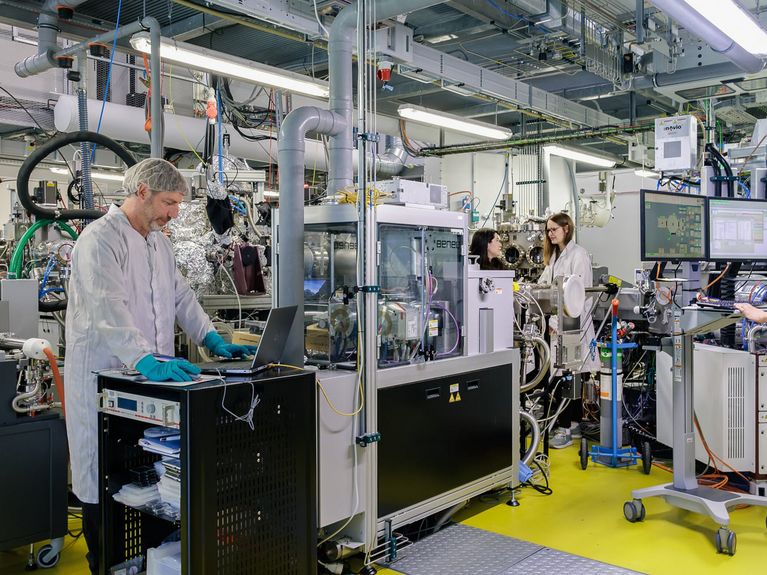
Photo: Kevin Fuchs / ASCEND
The ASCEND project aims to accelerate the development of new catalysts for the production of sustainable chemicals and renewable fuels. Instead of relying on years of experimental trial and error, it combines artificial intelligence with automated laboratories.
New catalysts are considered key to many future technologies. They could help produce green hydrogen more efficiently, convert carbon dioxide into valuable chemicals, or produce synthetic fuels more cost-effectively. However, the search for suitable materials is time-consuming. Researchers can combine chemical elements in countless ways, and even the smallest changes in composition can alter a catalyst’s properties.
“Finding a new catalyst is like the proverbial search for a needle in a haystack,” says Karsten Reuter of the Fritz Haber Institute of the Max Planck Society. “The task is made more difficult by the fact that many catalysts change during use.” Structure, composition, and morphology continue to evolve under reaction conditions, and these changes can determine whether a material performs exceptionally well or degrades rapidly.
The ASCEND project aims to transform and accelerate the search for suitable material combinations. The acronym stands for Accelerated Solutions for Catalysis using Emerging Nanotechnology and Digital Innovation. The project is coordinated by Helmholtz-Zentrum Berlin (HZB) and the Fritz Haber Institute of the Max Planck Society. Over the next five years, six partners from academia and industry will develop new approaches to significantly accelerate the search for highly efficient catalysts by leveraging artificial intelligence, automation, and advanced nanotechnology. The Federal Ministry of Research, Technology, and Space has provided €30 million in funding for the project.
From Trial and Error to Data-Driven Research
“We are shifting catalyst development from a trial-and-error approach to a data-driven process,” says Michelle Browne of HZB, who leads the project together with Karsten Reuter. Until now, researchers have often searched for suitable materials through a combination of experience, theoretical considerations, and numerous experiments. ASCEND aims to transform this process fundamentally. Instead of testing individual candidates one after another, the partners plan to build large material libraries and screen them automatically.
Catalyst fabrication plays a key role in this process. Instead of producing materials in conventional powder form, the project relies on ultrathin films only a few atomic layers thick. These can be deposited onto substrates and analyzed in parallel at high throughput. This reduces material consumption while significantly increasing the number of possible experiments.
At the same time, automated laboratory platforms are being developed that can autonomously perform many experimental steps. Artificial intelligence will not only analyze data but will also increasingly help design new experiments. “Instead of an empirical search process, close feedback loops between experiments, data analysis, and AI will enable a much faster learning process,” explains Reuter.
From Years to Weeks
If successful, the approach could dramatically accelerate the development of new catalysts. “Once the necessary workflows are established, we could reduce catalyst development times from years to weeks,” says Browne. The goal is to create materials that make chemical reactions more efficient, durable, and cost-effective while avoiding the use of rare or problematic raw materials wherever possible.
The partners contribute in a variety of ways. Siemens Energy provides expertise in electrochemical CO₂ technologies, while Dunia Innovations complements the consortium with know-how in autonomous laboratories. BasCat, the joint research laboratory of BASF and the Technical University of Berlin, contributes many years of experience in the thermocatalytic conversion of carbon dioxide into value-added chemicals. BASF also contributes its expertise in thermocatalysis and laboratory automation. On the scientific side, the Fritz Haber Institute provides expertise in computational modeling and AI-supported experimental design. At the same time, HZB contributes its expertise in thin-film technologies, electrochemistry, and high-throughput platforms.
“Each partner brings essential expertise to the development of new catalysts,” says Browne. “Only by combining these strengths can we accelerate the discovery of new materials from years to weeks.”
More Than a Research Project
For Browne, however, the success of ASCEND lies not solely in the development of new materials. “We want to have a lasting impact on how catalysts are developed,” she says. The vision of the project partners extends far beyond catalysis research. The methods developed in the project could also be applied to other industrial processes in the future. The project partners hope that the approaches developed within ASCEND will become established beyond the consortium and be adopted by other research groups and companies.
In the long term, the five-year collaboration could evolve into a permanent research platform where academia and industry work together on AI-supported and automated materials research. If successful, the project could not only deliver new catalysts. It would also demonstrate how artificial intelligence, automation, and modern materials science can work together to transfer scientific discoveries into practical applications much more rapidly.
A New Era in Catalysis: ASCEND Launch in Berlin, €30 Million in Funding


Readers comments