New Cooling Technology for the Data Centers of Tomorrow
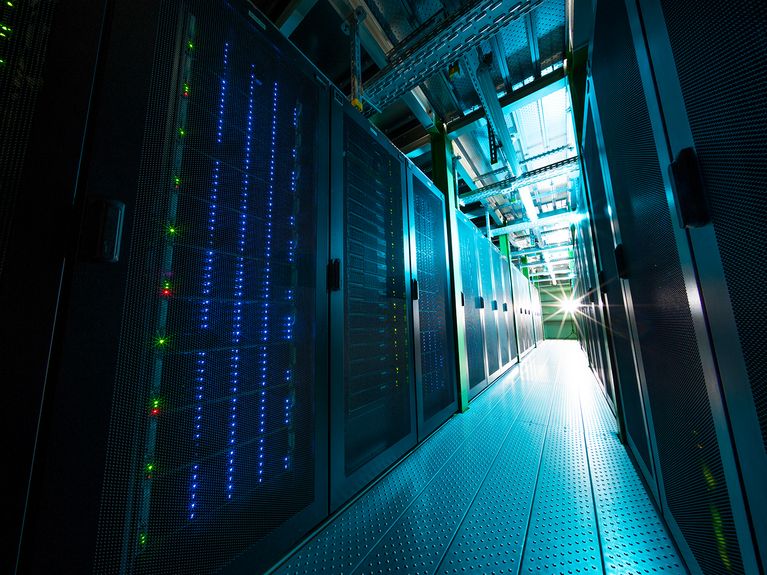
Inside the Green IT Cube at GSI/FAIR. Image: J. Hosan, GSI/FAIR
At the Green IT Cube at GSI/FAIR, researchers are working with industry partners to test a technology that cools processors directly with water—more efficiently and with the potential to make further use of the resulting waste heat.
Data centers are considered the heart of the digital world. At the same time, they are enormous heat generators. “Even a rack with a heat output of 20 kilowatts is enough to heat a single-family home,” says Helmut Kreiser of the GSI/FAIR particle accelerator center in Darmstadt. Racks are standardized server cabinets in which the computing power of modern computer clusters is concentrated. With the boom in artificial intelligence, the amount of power concentrated in these confined spaces is steadily increasing. The challenge, therefore, is no longer simply to provide sufficient computing capacity. The resulting heat also has to be removed from the systems.
Air Cooling Is Reaching Its Limits
Just a few years ago, most data centers could be operated using conventional air-cooling systems. But modern AI applications are fundamentally changing the requirements. High-performance processors and GPU clusters generate ever greater amounts of heat in confined spaces.
“You simply can’t get these amounts of heat out of the racks with air anymore,” the researcher explains. While conventional data centers often operate at power levels of a few kilowatts per rack, significantly higher power densities are already being discussed for current AI systems. The resulting heat can hardly be dissipated reliably using conventional approaches.

Philipp Müller of Rittal, Helmut Kreiser, and Thomas Weber of etalytics at the ZVEI award ceremony. Image: Marc Urban
The solution is surprisingly straightforward: water. The basic idea is not new. High-performance gaming PCs were already being equipped with water-cooling systems many years ago. “What is new above all is the scale,” says Helmut Kreiser. “Instead of individual computers, entire AI clusters with hundreds of high-performance processors now have to be cooled.”
For GSI/FAIR, this development comes as no surprise. Water-cooled rear doors have been used for years in the Green IT Cube, the research center’s energy-efficient data center. The air heated by the servers is cooled again directly at the rack. At the same time, GSI/FAIR uses the resulting waste heat to heat neighboring office and canteen buildings.
Cooling at the Source
However, as the power densities of modern AI systems increase, even this approach is reaching its limits. The heat has to be dissipated closer to where it is generated. This is where the collaboration with Rittal, a specialist in enclosures and data centers, and the Darmstadt-based deep-tech company etalytics comes in.
Instead of transferring the heat first to the air and then to a cooling system, the Cooling Distribution Unit (CDU) developed by Rittal for direct liquid cooling goes straight to the source. Water-based cooling circuits absorb the heat directly at the processors and transport it out of the system. “Transferring the heat directly from the heat source into a liquid is significantly more effective than taking the indirect route via the air,” says Kreiser.
The Green IT Cube provided ideal conditions for the development process. Unlike in a laboratory, the technology could be tested there under real-world conditions. The systems were not subjected to artificial loads but were integrated into regular research operations. Researchers used them for their calculations, while the project partners collected data on the cooling system’s behavior and continued to optimize the systems.

Green IT Cube on the GSI site. Image: J. Hosan, GSI/FAIR
“We don’t provide a laboratory in the traditional sense, but a real data center with real users and real applications,” says Helmut Kreiser. The experience gained from these live operations helped to gradually refine the technology and prepare it for practical use. At the same time, it provided valuable data on the behavior of modern AI systems. Their load fluctuations are significantly greater than those of conventional computer clusters. etalytics therefore developed AI-based methods that continuously optimize the operation of the cooling system.
Heat as a Resource
For this collaboration, Rittal, GSI, and etalytics received the Electrifying Ideas Award from ZVEI e. V. in May 2026. The award recognizes innovations that use energy more efficiently and enable progress for business and society.
For Kreiser, the significance of the project extends beyond cooling alone. Modern AI data centers must not only be powerful but also energy-efficient and scalable. At the same time, direct water-cooling systems open up new possibilities for utilizing waste heat. While conventional data centers generally operate with comparatively low water temperatures, direct liquid cooling systems reach significantly higher temperature levels. This could make it easier in the future to integrate their waste heat into heating networks or other applications.
The expansion of powerful AI infrastructure is therefore not simply a matter of faster processors. Equally important is the ability to manage the resulting heat efficiently and put it to good use. Technologies such as the direct water-cooling system tested in the Green IT Cube could help bring the growing energy demand of future AI data centers under control.


Readers comments