Awarded
Helmholtz Doctoral Prize for Outstanding Research Achievements
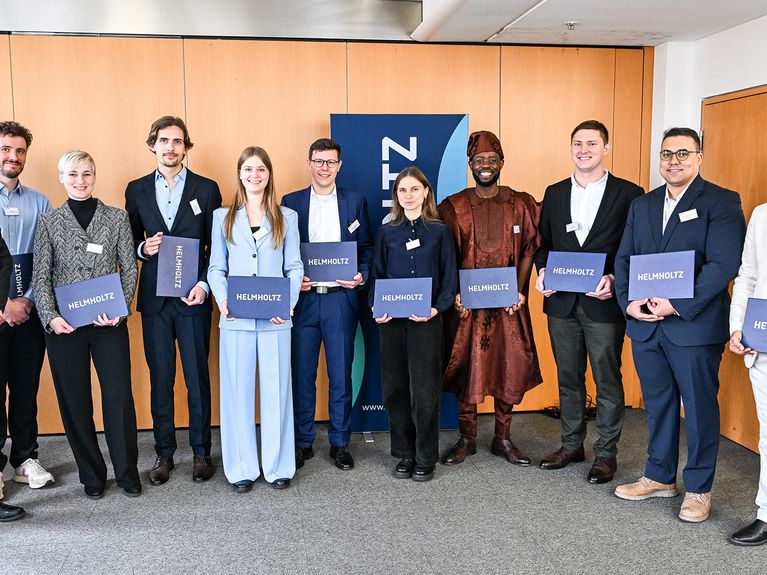
Image: Helmholtz/Oliver Walterscheid
At Helmholtz, more than 8,000 doctoral candidates conduct research. Eleven of them have now been honored. Each year, Helmholtz awards the best and most original doctoral theses with the Doctoral Prize.
Mariam Amghar
Deutsches Krebsforschungszentrum - DKFZ
For patients with advanced, treatment-resistant prostate cancer, therapeutic options are often limited. Targeted radionuclide therapies offer new hope, but predicting which patients will benefit remains a major challenge. In her doctoral research at the German Cancer Research Center (DKFZ), Mariam Amghar investigates how tumor DNA circulating in the blood can be used to predict and monitor treatment response at an early stage. By combining molecular analyses with clinical and imaging data, she aims to identify patients most likely to benefit from treatment and detect emerging resistance earlier. Her research lays the groundwork for more personalized cancer care, with the potential to reduce unnecessary side effects and healthcare costs while giving patients more precious time with their families.
Timur Bikulov
Forschungszentrum Jülich / RWTH Aachen
Magnetic nanoparticles have many potential applications in biomedicine, but precise characterisation of their magnetic properties is required for their targeted use. During his doctoral research at Forschungszentrum Jülich, Timur Bikulov advanced the theoretical description of nonlinear magnetic frequency mixing effects, developing a new measurement method based on these insights. This method directly probes the nonlinear response at its greatest sensitivity to the properties of the particles, achieving significantly higher resolution than established techniques. A compact, laboratory-grade measurement device enables the rapid and precise characterisation of magnetic nanoparticles, including their magnetic core size distribution and relaxation profile. Thus, his work provides an important foundation for quality assurance and the further development of nanoparticle-based technologies.
Katrin Geng
Karlsruher Instituts für Technologie / Helmholtz-Institut Ulm
Lithium-metal batteries promise particularly high energy densities, but safety and stability issues at their internal interfaces continue to hinder widespread use. During her doctoral research at the Helmholtz Institute Ulm, part of the Karlsruhe Institute of Technology (KIT), Katrin Geng investigated processes at the interface between lithium and solid polymer electrolytes. She developed and validated a reliable method for determining charge-transfer resistance and analysed its influence on the reversibility of lithium deposition and dissolution. She also clarified how the mechanical properties of the polymer electrolyte affect the shape and structure of lithium deposits. Her findings deepen our understanding of this crucial interface and provide valuable guidance for developing safer, high-performance lithium-metal batteries.
Laurids Jeppe
Deutsches Elektronen-Synchrotron / Universität Hamburg
Top quarks are the heaviest known elementary particles and offer a unique way to explore nature’s fundamental building blocks and forces. During his doctoral research at DESY, Laurids Jeppe analysed data from the CMS experiment at CERN and made the first measurement of the top–antitop production cross section at a collision energy of 13.6 teraelectronvolts. He played a leading role in the first observation of toponium, a short-lived system consisting of a top quark and its antiquark. In addition, he searched for additional Higgs-like particles that could provide evidence of physics beyond the Standard Model and possible connections to dark matter. His work enables precise tests of the Standard Model and opens up new insights into the strong interaction in the heaviest quark sector.
Maximilian Mennicken
Deutsches Zentrum für Luft- und Raumfahrt / Universität der Bundeswehr München
Propulsion systems closely integrated into the aircraft can make aviation more efficient, but they place particular demands on fan design. These fans also ingest the slower-moving air along the aircraft’s surface and must operate reliably despite the resulting uneven inflow. During his doctoral research at the German Aerospace Center (DLR), Maximilian Mennicken developed a method that captures the interaction between the air intake and the fan at an early design stage. By combining established simulation methods with a new preliminary design approach, it enables the coordinated design of the propulsion system and aircraft while accounting for aerodynamic and mechanical loads. His work thus provides an important foundation for robust, more efficient propulsion systems and more climate-friendly aviation.
Israel Ibukun Olaniyan
Helmholtz-Zentrum Berlin für Materialien und Energie / Freie Universität Berlin
Smaller, energy-efficient electronic components are required to enhance the strength and reliability of processing information. During his doctoral research at the Helmholtz Centre Berlin, Israel Ibukun Olaniyan fabricated lead-free ferroelectric barium titanate nanostructures on silicon and investigated their electrical properties. He demonstrated swirling polarisation states with a distinct handedness that can be reversibly switched using electrical pulses for the first time in these nanostructures. He also produced multiple distinguishable polarisation states for potential analogue memory applications, and demonstrated that ultraviolet (UV) light can alter the polarisation and crystal structure of thin films. His findings provide important foundations for compact, energy-efficient memory, switching and sensing devices based on established silicon technology.
Tainã Marcos Lima Pinho
Alfred-Wegener-Institut / Universität Bremen
How the East Antarctic Ice Sheet responds to climate change is crucial to the evolution of sea levels and global ocean circulation. During his doctoral research, Tainã Marcos Lima Pinho used multiple geological climate indicators to reconstruct the ice sheet’s dynamics and its interactions with the Southern Ocean and the Atlantic over the past 75,000 years. He identified close links between changes in atmospheric and ocean circulation in subtropical and polar regions, which influenced processes including meltwater input and Antarctic Bottom Water formation. Variations on millennial timescales were associated both with periodic changes in solar radiation and with a climate pattern resembling today’s Southern Annular Mode. His findings help explain how oceans and ice sheets respond to global warming and, through feedback mechanisms, help shape the climate.
Pia Rautenstrauch
Max Delbrück Center / Humboldt-Universität zu Berlin
Modern single-cell analyses capture different molecular properties of thousands of cells, but reliably integrating these large and often incomplete datasets remains a major challenge. During her doctoral research, Pia Rautenstrauch developed “liam”, a deep learning model that integrates different molecular data modalities and delivers robust results even when data quality varies and some measurements are missing. She also demonstrated that a widely used evaluation metric can yield favourable scores even when data integration fails, and developed approaches for more meaningful comparisons. In a collaboration investigating congenital muscle diseases, she also helped build a “digital twin” of muscle development, intended to support the identification of disease-related variants outside protein-coding regions. Her work thus provides important methodological foundations for reliably analysing single-cell data and applying them to rare disease research.
Hannes Rox
Helmholtz-Zentrum Dresden-Rossendorf / Technische Universität Dresden
Hydrogen production through water electrolysis needs to become more efficient, affordable and sustainable, but gas bubbles on electrodes can hinder electrochemical processes. During his doctoral research, Hannes Rox performed the first simultaneous measurements of bubble distributions and electrochemical parameters to assess their influence more precisely. Together with the Chair of Fluid Mechanics at TU Dresden, he developed a membraneless alkaline electrolyser that uses no PFAS materials and separates hydrogen and oxygen through controlled fluid flow. In collaboration with the Chair of Laser-Based Manufacturing at TU Dresden, he also developed electrodes with regions of differing wettability that prevent gas bubbles from blocking the catalyst, thereby reducing the required cell voltage. His work provides important approaches to more energy-efficient hydrogen production and the further development of sustainable electrolysis technologies.
Pallav Kumar Shrestha
Helmholtz-Zentrum für Umweltforschung / Universität Potsdam
Reliable flood warnings require precise river discharge calculations, yet small catchments and dams remain inadequately represented in global hydrological models. During his doctoral research at the Helmholtz Centre for Environmental Research (UFZ), Pallav Kumar Shrestha developed new methods to represent these effects across different spatial scales within the mHM hydrological modelling system. These advances enable more accurate, location-specific discharge estimates in managed river reaches worldwide, improving essential input data for flood early warning systems. His findings also provide a foundation for proactive water management that addresses both floods and droughts. Together with stakeholders in the water sector in Nepal, he is also advancing the implementation of the enhanced model in his home country as a pilot project for mountainous regions with limited observational data.
Johanna Wydra
Karlsruher Institut für Technologie
The flow behaviour of tritium gas is important both for future fusion power plants and for precise measurements of the neutrino mass, but experimental knowledge of it has remained limited. During her doctoral research at the Tritium Laboratory Karlsruhe, Johanna Wydra made the first measurements of the viscosity of molecular tritium at temperatures ranging from 100 to 300 kelvin. To achieve this, she developed and validated a new measurement apparatus suitable for use with radioactive tritium at low temperatures. Her findings provide important input data for modelling and monitoring tritium circuits in fusion facilities and help reduce systematic uncertainties in the KATRIN experiment’s determination of the neutrino mass. The measurement infrastructure also offers opportunities for industrial applications, including investigations into the properties of different gases and gas mixtures.


Readers comments