Interview
“Diversity, Equity & Inclusion is not the responsibility of a few ‘designated’ individuals, but must be supported by everyone.”
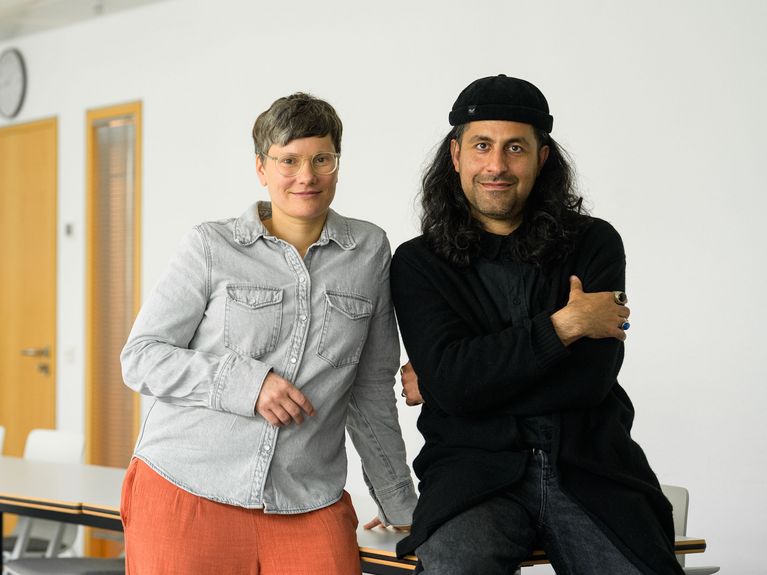
Anne Freese of the Deutsches Elektronen-Synchrotron DESY and Gholamhossein Movahedian of the German Cancer Research Center (DKFZ) are the spokespersons for the Helmholtz Network Diversity, Equity & Inclusion. Photo: Helmholtz/Phil Dera
Anne Freese and Gholamhossein Movahedian are the spokespersons for the Helmholtz Network for Diversity, Equity & Inclusion. In this interview, they discuss what the network’s work entails, why diversity, equity, and inclusion is a leadership issue, and how we can still improve in this area.
Why is diversity important, especially in science?
Gholamhossein Movahedian: Science thrives on methodological criticism, precise research questions, and the ability to continually re-examine one’s own assumptions. Diversity is important for this because different professional, social, and biographical perspectives can help broaden research questions and identify gaps earlier. Especially in health and cancer research, this isn’t just a question of representation, but also one of scientific quality. If certain groups, life realities, or caregiving contexts are not adequately accounted for in data, study populations, or research questions, the results may be less robust or less generalizable. Diversity and equity are therefore not at odds with scientific excellence; they’re one of the prerequisites for responsible and high-quality research.
Are there also blind spots to which science is particularly susceptible?
Anne Freese: Yes, there are, though I wouldn’t call them blind spots, because many visually impaired people reject that metaphor. I’d rather speak of blank spots. While we assume that the “best minds” prevail in science, in reality, outstanding potential is repeatedly wasted or overlooked because the demands of a scientific career are so rigorous. Women, people from non-academic backgrounds, people with disabilities, and those who have caregiving responsibilities for others encounter visible and invisible barriers alike. The academic world likes to see itself as international. Upon closer inspection, however, this internationality is heavily shaped by a European-Western perspective. Age discrimination is also widespread due to the standardized academic career path. Studies show that discrimination in academia is just as prevalent as in other professional fields. But we can do something about it!

Dr. Anne Freese is Coordinator for Diversity & Inclusion at the Deutsches Elektronen-Synchrotron DESY. Photo: Helmholtz/Phil Dera
What kinds of questions or experiences do employees bring to you?
Freese: The range is broad. Some people, for example, report specific incidents, such as experiences of discrimination and physical barriers that have led to accidents on campus for visually impaired colleagues. But I also want to mention the proactive inquiries from my colleagues who are striving for gender-inclusive language in internal documents and for inclusive leadership within their teams. Overall, I sense a desire among the staff to engage in constructive dialogue about identity, needs, visibility, resources, and opportunities for change in the workplace. This dialogue can positively influence an organization and support diversity as a leadership priority.
What specific steps are you and your colleagues taking to promote diversity, equal opportunity, and inclusion?
Movahedian: Our work operates on multiple levels. On the one hand, we create awareness-raising and dialogue formats, for example on discrimination, power dynamics, privilege, inclusive language, or belonging. On the other hand, it’s about counseling and guidance: employees, teams, and managers need spaces where uncertainties, experiences of discrimination, or conflicts can be professionally addressed. But the structural level is crucial: “Diversity, Equity, and Inclusion” (DEI) must be integrated with leadership culture, talent development, recruitment, communication, accessibility, complaint-filing procedures, and organizational development.

Gholamhossein Movahedian is Diversity, Equity und Inclusion (DEI) Manager at the German Cancer Research Center (DKFZ) in Heidelberg. Photo: Helmholtz/Phil Dera
Who needs to be on board in order for your work to have an impact?
Freese: We exchange ideas with the equality and inclusion officers, the representatives for employees with severe disabilities, as well as with the works councils, HR (development) and PR departments. With the “Network for Diversity, Equity, and Inclusion,” we at the Helmholtz Association have created a much-needed and trusting space where DEI leads from the various centers can share their expertise and offer each other collegial advice. In addition, some centers have employee networks that pool the expertise and experiences of employees, facilitate networking, and, in the best cases, also foster empowerment and solidarity. As at DESY, this can take the form of a “Diversity Roundtable,” or it can include queer networks, neurodiversity networks, or networks of People of Color (PoC). What is crucial, however, is that the leadership of the respective centers stands behind our work, because true equal opportunity requires a cultural shift throughout the entire organization. And that must be driven by the leadership. DEI is not the responsibility of a few “designated” individuals, but must be supported by everyone.
Movahedian: I see it exactly the same way. DEI officers can contribute expertise, raise awareness, provide advice, and initiate processes. But sustainable change does not come about solely through individual specialized units. It happens in everyday life: in hiring and promotion processes, in mentor-mentee relationships, in meetings, in laboratories, in communication, and in leadership decisions. That is why, in addition to the designated officers and specialized units, what is needed above all is clear support from the leadership, active responsibility on the part of managers, and collaboration with HR, talent development, communications, employee representatives, and the teams themselves. It is crucial that DEI is not viewed as an additional task for individual people, but rather as an integral part of a strong organizational and leadership culture.
Are there any trends that you find concerning?
Movahedian: I’m concerned that diversity and anti-discrimination are becoming more polarizing in society and, in some cases, are being delegitimized. This can lead people to feel uncertain about whether their experiences are being taken seriously, and it can cause organizations to become more cautious, even though reliability is especially important right now. At the same time, certain groups – such as queer people, people who have experienced racism, Jewish people, Muslims, people with disabilities, or internationally mobile researchers – are facing increasing pressure, hostility, or uncertainty even outside of academia. This creates a special responsibility for research institutions like Helmholtz: we must create safe, respectful, and anti-discriminatory working environments without narrowing the issue to party politics. It is about the rule of law, duty of care, academic freedom, and good working conditions.
How do we define diversity?
Diversity is often translated as “variety.” We associate this with a conscious and appreciative approach to differences within our workforce and their varying needs at the workplace, as well as protection against discrimination on the part of the employer. After all, in academia, as in society as a whole, there are mechanisms of inclusion and exclusion – for example, based on categories of difference and dimensions of inequality such as gender and gender identity, age, religion and worldview, social background, sexual orientation, ethnicity, nationality and racial attribution, physical and mental abilities, caregiving responsibilities, and many other categories. These experiences also overlap within a single person and interact; we refer to this as “multiple discrimination.”
In our work, we analyze how organizations deal with diversity: Which perspectives are taken for granted? Which experiences remain invisible? Who gains access to resources, networks, security, and recognition? And who must overcome additional hurdles? That is why we always consider diversity in conjunction with equity and inclusion. Diversity describes not only representation but also power relations, institutional norms, and unequal starting conditions. Equal opportunity asks whether the procedures used are actually fair. Inclusion means designing structures so that people are not merely represented but can also participate effectively. Diversity is therefore not a mere decorative value but a critical measure of an organization’s quality. And in academia, it is also a measure of the quality of the conditions for knowledge production.
(Anne Freese & Gholamhossein Movahedian)
Related articles



Readers comments