Helmholtz Wasser-Initiative
“We must overcome sectoral fragmentation.”
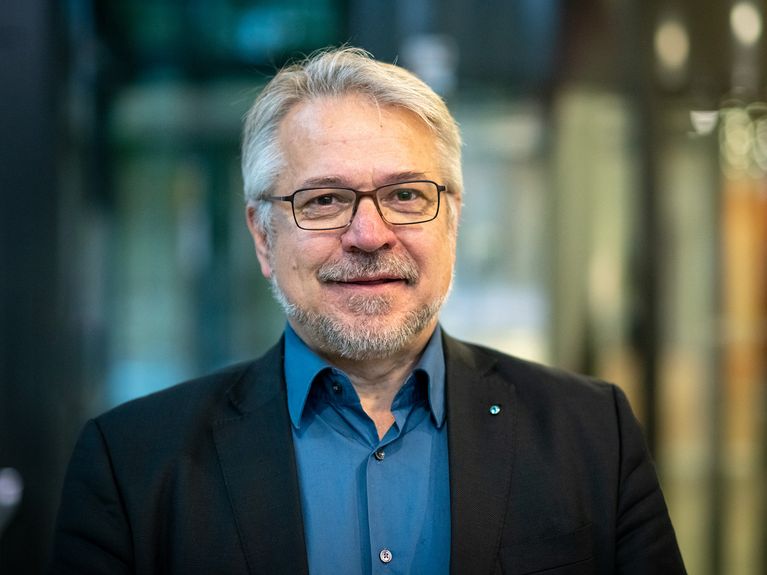
Prof. Dr. Dietrich Borchardt is a hydrobiologist at the Helmholtz Centre for Environmental Research (UFZ) and spokesperson for the Helmholtz Initiative “Water Security for People and the Environment in the 21st Century”. Image: UFZ
Drought and heat stress, as well as floods and heavy rainfall, are significantly altering the water cycle in Germany. In this interview, water expert Dietrich Borchardt discusses how a Helmholtz initiative is combining data, research, and practical application to manage water proactively in the future.
This year, the Helmholtz Association launched the Helmholtz Initiative ‘Water Security’, in which nine Helmholtz Centres are participating. Why is the topic of water security so important?
Water is an essential resource that permeates all areas of life and the economy, including drinking water supply, agriculture, industry, shipping, the energy sector, and waste management. Water supply remains reliable, and Germany is a water-rich country. However, due to climate change, we can no longer take this for granted—extreme events are increasing. We must adapt to these changes.
What makes the Helmholtz Initiative special?
The initiative stands out for two main reasons. First, we have made significant advances in research and innovation, for example, in information and sensor technology, Earth observation, and data modeling. In the past, however, we have largely been reacting to events—we need to change that. Through real-time monitoring and forecasting, we will be able to take a far more proactive approach to extreme events such as floods in the future and prevent damage. Second, we aim to develop and test these solutions in close coordination with local decision-makers.
Why is it important to involve stakeholders?
Currently, decision-makers tend to operate within their own sectors. Some are responsible for flood protection, low-water management, or agriculture, while others handle drinking water or industrial water. We must overcome this sectoral fragmentation. To achieve this, we need new formats of collaboration—and this is where the three Solution Labs of the Water Initiative come in.
What might that look like, for example, in the SOLVE Solution Lab for the Elbe?
The Solution Lab aims to develop solution options for a resilient landscape water balance in the Elbe River basin. A central theme is water storage in the landscape. This approach, for example, benefits agriculture, flood protection, biodiversity, and drinking water security. To this end, we bring these sectors together so that all stakeholders can benefit from a single measure.
Thousands of measures have already been implemented along the Elbe, ranging from renaturation to technical interventions. Were they ineffective?
The responsible authorities carried out many measures on a sectoral and local basis—here, the renaturation of a stream section; there, the construction of a stormwater retention basin. However, individual measures are inevitably limited in scope. We aim to develop solutions from the perspective of the entire river basin. For example, where does it make sense to retain water in the landscape? Where is groundwater recharge most effective? How can we most effectively improve the ecological condition of the Elbe and its tributaries? We seek to identify solutions that benefit the entire Elbe River basin.
How do you proceed?
For example, we rely on functional digital twins not only in the Elbe basin but also in the Solution Lab Rur–Erft; however, they are not purely science-driven. We are not particularly interested in what groundwater recharge or soil moisture looks like on a single square meter of land daily, because few users can make effective use of that level of detail. If decision-makers receive this data in an aggregated and tailored form, they can assess the effectiveness of a measure more accurately, thereby increasing its relevance. In this way, we place greater emphasis on user needs. We also leverage innovations from the scientific community. For example, the GFZ Helmholtz Centre for Geosciences has developed a new technology that uses satellite gravimetry methods to estimate groundwater volume. This metric is often more meaningful to stakeholders than the groundwater level. We aim to translate such innovations into practical applications.
What does such knowledge transfer look like for the Solution Lab Rur–Erft?
A network of dams characterizes the Rur–Erft river basin. Engineers built these reservoirs more than 100 years ago and designed them for the water volumes and demands that prevailed at that time. The question is whether this is sufficient for current and future needs. We need to revise dam management rules to ensure water security. In response to such scenarios, we are developing a functional digital twin to control the dams more intelligently, leveraging hydrological models and AI-supported modeling.
In the Solution Lab URBAN LE, Leipzig is to be developed into a model city for integrated blue-green-red urban development. How can this be achieved?
Cities face the challenge of using stormwater more sustainably. During precipitation events, water can follow only three pathways: it can evaporate, infiltrate into the ground, or run off over the surface. In urban areas, the vast majority of precipitation ends up in the sewer system. In a near-natural water cycle, however, this accounts for only about 20 percent—and that is precisely our vision for Leipzig. Using innovative measurement and control technologies and blue-green infrastructure, planners aim to distribute precipitation more effectively to manage extreme events such as heavy rainfall and droughts.
What makes you optimistic that the Solution Labs will be successful?
We need best-practice examples to demonstrate the current state of science and technology in water security and the opportunities offered by climate adaptation. Achieving this requires bold and innovative stakeholders who take on pioneering roles and develop new approaches. Through this new form of cooperation between science and public administration, we can arrive at systemic solutions more quickly.
Dietrich Borchardt is a hydrobiologist at the Helmholtz-Zentrum für Umweltforschung (UFZ) and spokesperson for the Helmholtz-Initiative „Water Security for People and the Environment in the 21st Century.”


Readers comments