National Decade Against Post-Infectious Diseases
When the infection is over and the disease is just beginning
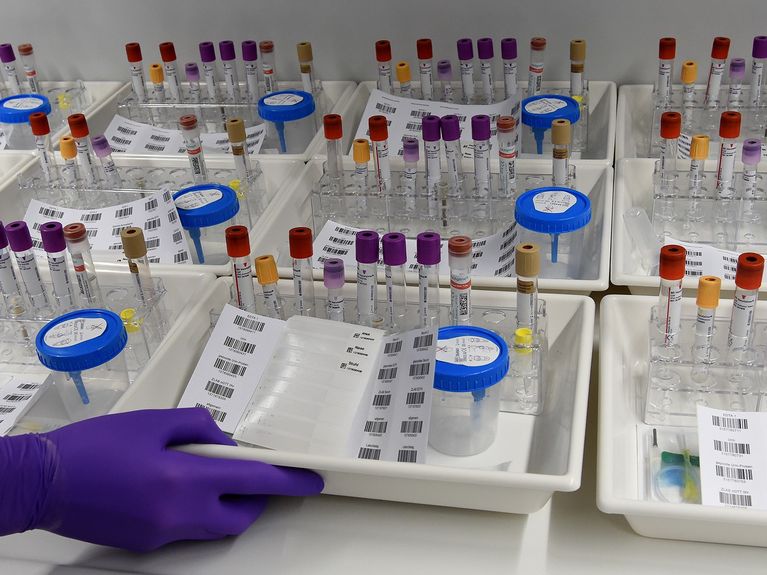
Collection kits for biological samples from study participants at the NAKO Study Center in Hanover. Image: Holger Hollemann/dpa
Long COVID, ME/CFS, and other post-infectious diseases pose new questions for medicine and society. With the long-term data from the NAKO Health Study, Germany now aims to systematically clarify why some infections leave lasting effects and how those affected can be better supported.
- Post-infectious diseases are on the rise. Infections such as COVID-19 can lead to chronic conditions such as Long COVID or ME/CFS months or even years later, affecting hundreds of thousands of people in Germany.
- As part of the National Decade Against Post-Infectious Diseases, the Federal Ministry of Research, Technology, and Space (BMFTR) is investing approximately 500 million euros over the next decade to systematically research causes, disease mechanisms, diagnostics, and therapies and to improve care.
- The NAKO Health Study, with 200,000 participants, provides crucial long-term data and enables a rare before-and-after comparison with data and biosamples from before, during, and after infection.
- The aim of research is to determine the actual prevalence of post-infectious diseases more accurately, to better understand the underlying biological processes, and to effectively support those affected through targeted interventions in the future.
The problem sometimes only begins once the danger has been averted and defeated. Individuals become infected with viruses or other microorganisms; their immune system becomes active, they may develop a fever and feel somewhat weakened while the battle rages inside their body. Eventually, the intruders are defeated, the infection is largely overcome, and things should actually start to improve. Instead, sometimes after a break of a few days to many years, depending on the disease, a new disease develops, presumably caused by immune dysregulation or pathophysiological processes during the infection. Such a disease is referred to as a post-infectious disease.
One particular form has been on everyone's lips since the coronavirus pandemic and has reached new proportions: Long COVID, characterized by fatigue, reduced resilience, cognitive impairment ("brain fog "), and shortness of breath persisting for weeks to months after a SARS-CoV-2 infection. The incidence of myalgic encephalomyelitis or chronic fatigue syndrome (ME/CFS) has also skyrocketed. ME/CFS refers to a severe, chronic multisystem disease that often occurs after an infection and is characterized primarily by pronounced exhaustion that worsens significantly after exertion. According to expert estimates, approximately 870,000 people in this country were living with Long COVID and 650,000 with CFS by the end of 2024.
Ten years of research into the long-term effects of infections
Since the pandemic, post-infectious diseases have become an increasingly important issue, not only medically but also socially, with far-reaching consequences for those affected and the healthcare system. To counteract this, the Federal Ministry of Research, Technology, and Space, together with the Federal Ministry of Health and other partners, launched the "National Decade Against Post-Infectious Diseases " at the beginning of this year. The aim is to systematically research the causes, disease mechanisms, diagnostics, and therapies of post-infectious diseases, including Long COVID and ME/CFS, over the course of a decade, while also developing new care pathways. A total of around 500 million euros, or about 50 million per year, has been earmarked for this purpose, which will be invested in interdisciplinary projects, data infrastructures, and clinical studies.
"The better we understand the causes and disease mechanisms, the better we can prevent and treat them. This is especially true for post-infectious diseases: their disease mechanisms are still poorly understood, so there is a lot to do and discover, " explains Annette Peters, Chair of the NAKO Health Study and Director of the Institute of Epidemiology at Helmholtz Munich.
The NAKO- Health Study is involved in several important projects as part of the National Decade Against Post-Infectious Diseases. This is hardly surprising, given that NAKO is particularly well-positioned to contribute its strengths effectively in this area. It is Germany's largest population-based long-term study to date. Since 2014, approximately 200,000 men and women aged 20 to 69 have undergone medical examinations throughout Germany and are regularly asked about their state of health, lifestyle habits, and environmental factors.
A valuable before-and-after view
"In order to better understand post-infectious diseases, it is ideal to be able to make a before-and-after comparison. This is exactly what NAKO enables us to do: we have data and biological samples, such as blood samples, from our participants from before, during, and after the pandemic, " explains Peters. This is precisely the advantage offered by EpiPAIS (Epidemiology of Post-Acute Infection Syndromes), a central project of the Decade based at NAKO. EpiPAIS is conducting in-depth examinations of approximately 4,500 NAKO participants, for whom a before-and-after comparison is particularly feasible.
The researchers are trying to keep the comparisons as broad as possible. This is because the exact mechanisms that cause a recovered infection to develop into a chronic disease have not yet been conclusively clarified. Among other things, they are discussing persistent dysregulation of the immune system, including chronic inflammatory activity, autoimmune reactions against the body's own structures, and viral components that remain in the body even after infection and continue to stimulate the immune system. Vascular dysfunction, microthrombi, changes in the autonomic nervous system, and metabolic and mitochondrial dysfunction are also suspected of contributing to symptoms such as fatigue, cognitive impairment, and shortness of breath. "It is probably not a single trigger, but rather an interaction of several factors that varies depending on the infection and individual predisposition, " says Peters.

Annette Peters, Chair of the NAKO Health Study and Director of the Institute of Epidemiology at Helmholtz Munich. Image: Helmholtz Munich
The first step is to clarify how many people are actually affected by Long COVID.
In the vast majority of cases, however, the body's own immune system appears to play an important role. EpiPAIS therefore focuses, among other things, on changes affecting the body's complex defense system. For example, it is investigating whether the number of certain leukocytes – i.e., white blood cells – has changed in people with post-infectious diseases and whether epigenetic patterns of immune cells have shifted, i.e., chemical markers on the genome that control which genes are active or inactive in a cell without changing the DNA sequence itself. At the same time, the researchers are specifically looking for protective factors, i.e., biological or lifestyle characteristics that protect against severe disease progression. "This may also contribute to identifying therapeutic approaches, " says Peters. The analyses have already begun, and Peters is confident that several findings will be available as early as next year.
And then NAKO seeks to clarify a very fundamental question: How many people in Germany actually suffer from certain post-infectious diseases? "Long COVID, for example, is still not uniformly recorded, so we don't know how many people in this country suffer from it, " says Peters. Because the NAKO follows the 200,000 participants in close detail, it could also provide important insights into the prevalence of post-infectious diseases.
How widespread are the invisible traces of past infections?
Another NAKO research project within the framework of the National Decade Against Post-Infectious Diseases is investigating antibodies against various pathogens and their prevalence in the population. Several thousand NAKO participants will be analyzed to determine how many people carry antibodies against different pathogens, how strong these antibodies are, and how these markers change over time. Such serological analyses provide clues as to how the immune system has responded to past infections and which profiles may be associated with a lower or higher risk of post-infectious diseases.
These data not only allow conclusions to be drawn about the distribution of immune responses in the population, but also enable correlations between previous infections, immunological reactions, and long-term health consequences to be investigated, for example, whether certain antibody constellations are associated with a lower risk of severe post-infectious progression. These findings can also help to identify protective factors and better understand immune responses, which in turn can contribute to the development of prevention or treatment approaches.
"Which viral infections are associated with which post-infectious diseases? Which factors increase or decrease the risk, and why? What factors contribute to recovery from a post-infectious disease? These questions show that we are still in the early stages of understanding and that some fundamental issues still need to be clarified," says Peters. The NAKO's biomedical data and projects could soon help answer some of these open questions, thereby contributing to the first comprehensive successes of the National Decade Against Post-Infectious Diseases.



Readers comments