Interview
“We should also incorporate Indigenous knowledge”
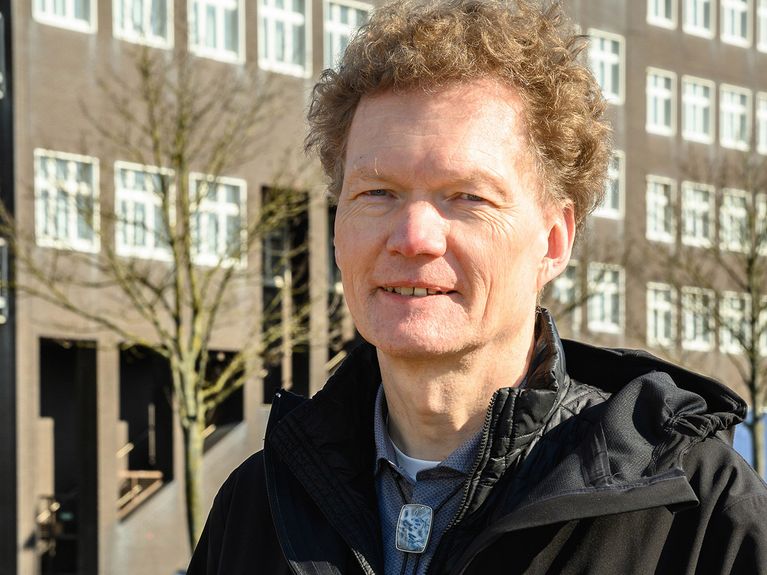
Image: AWI / Kerstin Rolfes
Hajo Eicken is to become the new director of the Alfred Wegener Institute in Bremerhaven, returning to Germany after nearly three decades in Alaska. A conversation about his experiences with sea ice, his view from Alaska, and his vision for holistic polar research.
Professor Eicken, as a glaciologist, you could hardly be closer to the ice than you were at your previous post in Alaska, could you?
That’s true; from Fairbanks, the ice was practically within commuting distance, so to speak. If I flew out in the morning, I could be standing on sea ice at the edge of the Arctic Ocean by the afternoon.
So what drew you to Bremerhaven?
Nearly 30 years ago, I deliberately chose the opposite direction: I wanted to be closer to the ice. However, research has since evolved. The oceanic ice cover and its significance have now become firmly established in public awareness, a development that was not previously the case. It is now widely recognized that sea ice plays a crucial role in ecosystems, society, and economic activities. I have become increasingly interested in these interconnections, and at the Alfred Wegener Institute, I aim to pursue holistic polar research.
What have you taken away from your time so close to the ice?
In Alaska, I realized early on how rapidly conditions are changing and how quickly the ice is melting. I observed this firsthand. We typically conducted fieldwork on the ice in November to install instruments that recorded baseline data over several months, including temperature, ice salinity, thickness, and rates of ice growth and melt. In November, the landfast ice was between 30 and 50 centimeters thick and could easily support both us and our equipment. By mid-June, we would return to retrieve the instruments. I first conducted this work in 1999; however, from 2004 onward, it has no longer been possible to conduct fieldwork in November—sometimes we have had to wait until January for stable ice conditions.
Where does your fascination with ice come from?
I have been interested in the natural world since childhood. My grandfather lived in a small village near Bremerhaven, where I spent a great deal of time and developed a deeper understanding of natural processes. Later, while on vacation in the Alps, I became fascinated by minerals; from there, the transition to ice was a natural one, as I regard it as rock that is very close to its freezing or melting point.
But for your master’s thesis, you were initially in Brazil…
…yes, it focused on mineral deposit geology. During a visit home, I met my future doctoral advisor, Manfred Lange, at a swimming club in Bremerhaven; this was in the early years of the AWI in the 1980s. At the time, he was looking for a student assistant to help prepare thin sections of ice, and that is how I became involved in glaciology—and, incidentally, how I joined my first expedition.
Tell us about it!
In 1986, the AWI was preparing its first large-scale winter expedition, bringing together leading marine biologists. However, they also needed someone to process ice cores, prepare thin sections, and carry out basic measurements. Someone suggested, “We can send Hajo along.” I was the only undergraduate student on board the Polarstern at the time, and the experience was highly formative.
Now, many years later, you’re returning to the AWI. What new insights have you gained about the institute?
As a sea ice researcher, I was already familiar with the AWI’s work in this area. Nevertheless, much of it was unfamiliar to me. I was particularly impressed by both the breadth of the institute’s research and its consistently high standards.
What are your priorities?
In recent years, I have learned a great deal about “team science,” as it is referred to in the United States, including how interdisciplinary scientific teams should be structured and how effectively they can advance scientific research. This approach has always been particularly important in the polar regions, where expeditions are highly complex and bring together individuals with diverse areas of expertise in confined environments. I aim to bring this experience to the AWI. We should consider how to better support researchers in advancing their work while also improving overall team performance.
Please be more specific.
The AWI has traditionally focused on the natural sciences; however, it also includes a small group of social scientists. My vision is to establish the AWI, in collaboration with external partners, as a leading center for integrative polar research. While it is essential to understand the fundamentals of the Earth system, it is equally important to examine its interactions with and impacts on human societies. Achieving this will require more advanced approaches and a broader range of methods.
Are you thinking of AI and big data in this context?
Although big data has received considerable attention, the Arctic represents “small data with a large impact.”
When Fridtjof Nansen spent three years in the Arctic beginning in 1893, he measured water temperature and salinity—parameters that still form the basis of observational practice today. While autonomous sensor systems are now available, satellite remote sensing remains integrated with ground- and water-based measurements. However, scientific insight does not depend solely on large datasets: even a limited number of carefully selected measurements can provide critical understanding. At the same time, we should place greater emphasis on incorporating Indigenous knowledge, which offers valuable additional perspectives. This integrated approach is what I mean by holistic polar research.
What will it be like for you to return to Germany after nearly three decades?
(laughs) Even everyday life will likely feel like an adventure. In Alaska, I look out onto my own forest; when I look out the window, I might see a moose resting there. I had a great deal of freedom there—that will certainly be different in densely populated Germany.
What will be your first official act?
I am looking forward to meeting new colleagues and gaining a comprehensive understanding of the activities across the AWI and its various research stations. That is my top priority. Just yesterday, an old friend asked whether we might go paddling together again on the Geeste and Weser. I am very much looking forward to it—seeing seals and migratory birds and returning to the remarkable waterways around Bremerhaven.
Hajo Eicken has served as director of the Alfred Wegener Institute (AWI) in Bremerhavensince March 20. The glaciologist has worked at the University of Alaska Fairbanks since 1998, most recently as director of the International Arctic Research Center (IARC). After studying mineralogy at Clausthal University of Technology, he completed his doctorate at the University of Bremen and worked in the field of oceanic and atmospheric physics at the AWI.


Readers comments