Quantum technology
“We need to develop the ability to build these systems ourselves”
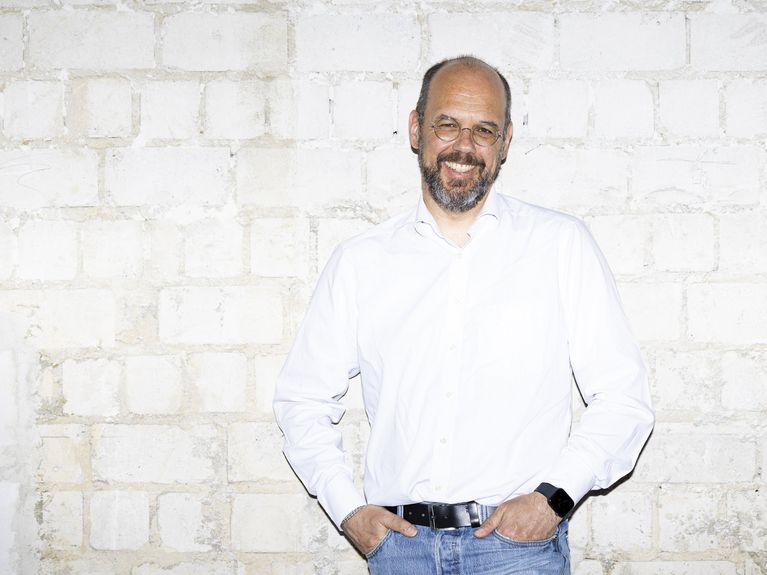
Prof. Dr. Tommaso Calarco, Director of the Quantum Control Division at the Peter Grünberg Institute, Forschungszentrum Jülich.Photo: Forschungszentrum Jülich / Sascha Kreklau
Tommaso Calarco heads the Institute for Quantum Control at the Forschungszentrum Jülich. In this interview, he discusses the challenges of quantum technology as well as Germany’s and Europe’s position in global competition.
Mr. Calarco, what are you personally researching at Forschungszentrum Jülich?
I head the Institute for Quantum Control. We develop software for quantum computers that operates similarly to drivers in conventional computers, directly at the hardware level, to ensure minimal error rates and high-fidelity qubit operations.
Qubits are the fundamental computational units of a quantum computer, comparable to bits in classical computing.
Exactly. In short, these quantum drivers ensure that the hardware operates optimally. This approach positions us at the Forschungszentrum Jülich as a link between hardware developers and algorithm developers, such as the Jülich Supercomputing Centre.
You are describing a holistic research strategy—the entire chain from hardware to software?
Yes, that is our strength. At the Forschungszentrum Jülich, we integrate all the necessary components within a single institutional framework. These include materials research, cleanroom-based nanofabrication capabilities, infrastructure for qubit circuit design and testing, algorithmic expertise, high-performance computing resources, and more.
The same applies to the Helmholtz Association as a whole; what distinguishes us is our holistic and systemic approach. Other institutions also conduct comprehensive research on quantum technologies—for example, the Helmholtz-Zentrum Dresden-Rossendorf, which is particularly strong in quantum sensing, and the German Aerospace Center (DLR), which is actively engaged in secure quantum communication research, both on Earth and in space.
Given such research centers, Germany should be in a very strong position in quantum technology.
Yes, Germany is among the leading countries in Europe.
However, there is strong competition from the United States and China. Google alone regularly reports new advances in quantum computing, while China is a global leader in quantum communication. Where do Germany and Europe stand in comparison to these countries?
Scientifically, we are fully on par in terms of expertise, competence, creativity, and research output. Where we are weaker, however, is in the private sector—particularly in terms of investments from large corporations and private investors. To the best of my knowledge, Google invests several hundred million U. S. dollars annually in quantum computing research. We certainly do not operate at that scale, nor do we have a venture capital ecosystem comparable to that of the United States.
Is there a risk of technological dependence, as seen with search engines or artificial intelligence, if we fail to keep pace?
It is not a matter of being the first to win the race. What is crucial is that we develop the capability to build these systems ourselves—so that we do not become dependent on others. Even if we were to come second, this would be far preferable to a scenario in which we fail to establish our own production capabilities in quantum technologies.
Is there any area in which Europe is ahead of the United States or China?
At a conference in Washington, D.C., an employee of the U. S. Department of Energy told me that, in the United States, there is a certain degree of envy toward Europe, as we provide public access to quantum computing systems, whereas the field there remains heavily dominated by large corporations such as IBM.
What does that mean?
We have established the Jülich Unified Infrastructure for Quantum Computing (JUNIQ), which enables scientists worldwide to access the quantum computers integrated as coprocessors in our supercomputers via the internet. This approach allows even users without a background in physics to work with quantum computers. In previous projects at JUNIQ, quantum computers have been used, for example, to optimize the allocation of individual aircraft across scheduled flights and to model the folding of specific proteins, thereby contributing to a better understanding of neurodegenerative diseases such as Parkinson’s disease.
You mentioned that, in Europe, the transfer of technology into practical applications is less effective than in the United States. How can this be improved?
At the Helmholtz Association, we have launched the Quantum Use Challenge to identify concrete use cases for quantum technologies. This initiative spans all Helmholtz research areas—from health to Earth and environmental sciences to energy. We are currently working on translating research questions from these domains into the framework of quantum technologies.
Can you give an example?
For example, quantum simulators can support materials research for battery applications. A quantum simulator can reproduce the behavior of a material or chemical system in a way that classical computers cannot efficiently simulate. Instead of relying solely on mathematical models of a molecule, it arranges atoms in a geometry similar to that of the actual molecule and adjusts their interactions accordingly. This approach yields valuable insights into material properties relevant to battery performance, including higher capacity, longer lifespan, and greater energy efficiency. Another example is the application of quantum computers in fluid dynamics, particularly in climate science. Artificial intelligence models are already widely used in this field, and the integration of quantum-computing-assisted AI is an active area of research.
When do you think quantum simulators or quantum computers will deliver the first practical benefits?
The timing of the first demonstration of quantum advantage remains uncertain. However, I am confident that quantum advantage will demonstrate its potential within the next ten years, particularly in the field of quantum simulation. We are working intensively on this at the Helmholtz Association.
Quantum Use Challenge
The Helmholtz Association is promoting the targeted transfer of quantum technologies into previously untapped fields of application. Our aim is to harness the potential of quantum computing, simulation, and sensor technologies for specific societal and industrial challenges where conventional methods are increasingly reaching their limits. To this end, the initiative brings together expertise from five Helmholtz research areas to develop more powerful batteries, visualize cancer cells and micrometastases at early stages, and create more realistic models of groundwater, energy, and environmental systems.
qFLOW develops quantum-assisted simulation methods for complex flow processes to solve pressing challenges in the areas of water, climate, and energy—thereby laying the foundation for digital twins of physical systems and the transfer of quantum technologies to environmental and energy research.
QT-Batt combines quantum computing and quantum sensor technology to model new battery materials more precisely and make the smallest changes in operation measurable – with the aim of developing longer-lasting, safer, and more powerful batteries for the energy transition.
QuBiopsy is developing a novel, multimodal quantum diagnostic that uses magnetic and photonic quantum technologies to visualize even rare tumor cells and micrometastases at an early stage and in high resolution – a promising approach for more precise early cancer detection and personalized oncology.
QuWIRK is developing specialized quantum algorithms for various phases of digital drug discovery—from the analysis of cellular data to the optimization of drug candidates—with the aim of enabling faster and more precise drugs against infectious diseases in the future.
Tommaso Calarco on Quantum Use - Future Forward



Readers comments