Interview
"Water has a democratic dimension"
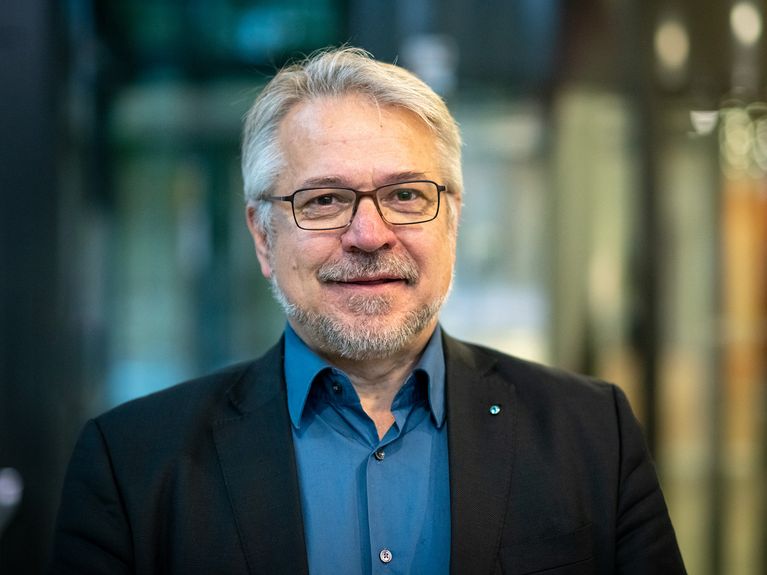
Prof Dr Dietrich Borchardt, Senior Adviser Helmholtz-Centre for Environmental Research – UFZ and Speaker Helmholtz Research Campaign “Water Safety and Security for Humans and the Environment in the 21st Century”. Picture: UFZ
A UN report recently warned of a "global water bankruptcy". In this interview, UFZ hydrobiologist Dietrich Borchardt explains the state of the world’s water resources and outlines what challenges Germany faces in protecting surface water and groundwater.
The United Nations University Institute for Water, Environment and Health (UNU-INWEH) entitled its latest report “Global Water Bankruptcy”. Is the state of global water reserves really so alarming?
The UN aims to highlight the urgency of the issue and demonstrate that some damage is now irreversible. I am rather sceptical about this choice of wording because I question whether the term is actually helpful. The report identifies real and, in some cases, serious problems with water availability and water quality. However, these are not new; they are merely being labelled differently. Even though there are many good regional examples around the world, a solution-oriented perspective with an analytical focus on the factors that contribute to successful water and aquatic ecosystem management is lacking.
What is the state of the global water balance?
Water has always been a key resource. In the 21st century, this is truer than ever. This applies to Germany, Europe, and the whole world. The water balance is characterised by considerable regional differences. Natural conditions for rainfall distribution and water storage vary widely, and water is being used ever more intensively in different ways and for different purposes.
In many developing and emerging countries, social and economic development is already being restricted – or will be in the near future – because there is simply not enough water available. Even in Europe and other highly developed regions, medium- to long-term protection against extreme events, reliable water use especially for drinking water, and sufficiently healthy aquatic ecosystems with adequate biodiversity are not assured. All these developments are influenced by the effects of climate change on the water cycle and are exacerbated in many regions of the world.
What problems are we facing in Germany?
In Germany, we have long been used to having groundwater and surface water available at any time, in high quality, and in ample quantities. However, water resources are also increasingly under threat in our part of the world. One reason for this is the climate crisis, which is having a widespread impact on the water balance, albeit with regional variations. Climate scenarios predict further rising temperatures and changing precipitation patterns. Climate models designed for precautionary planning indicate hotter and drier summers, greater fluctuations or decreases in soil moisture, and similar medium- to long-term trends in groundwater levels, particularly in regions already experiencing falling groundwater tables when human interventions in the water cycle are taken into account. This affects agricultural crops and grassland as well as forests and other ecosystems, especially water-based terrestrial ecosystems with protected species and habitats. Heavy rainfall and flooding are becoming more frequent while snowfall is becoming less common in winter. The climate crisis therefore has serious consequences for water availability. As a result, the risk of overuse has increased considerably. Unsustainable uses also play a role. All water use in urban and rural areas must therefore be adapted in such a way that both individual crisis events such as isolated floods and periods of drought and long-term changes in water availability such as less usable groundwater or declining water flow in rivers can be managed. Another threat and environmental policy challenge arises from pollution of water bodies with nitrogen and phosphorus as well as trace contaminants and microplastics.
Can this be expressed in figures?
The hydrological consequences of climate change alone have considerable economic implications and are closely linked to damage caused by heat, drought, and flooding. According to a Prognos study, damage caused by extreme weather in Germany between 2000 and 2021 is estimated at almost € 145 billion, including estimated indirect losses exceeding €30 billion.
This does not yet include damage caused by extreme events such as the 2021 flooding in the Ahr Valley. However, the humanitarian implications of these are particularly severe. The Ahr Valley floods claimed at least 135 lives. Current figures put the financial damage in the Ahr Valley at over €40 billion; this required a special federal fund, substantial insurance payouts, and considerable private investment. These dimensions of damage push even strong economies such as Germany to the limits of their capacity.
To solve the water problems in Germany, in 2023, the federal government adopted a “National Water Strategy”, which you helped to develop. Was the complex participation and consultation process worthwhile?
Yes, it was worth it in the end: Since 2018, across three federal governments and coalition agreements, the “National Water Dialogue” and the “National Water Strategy” have provided the framework for political action because they were developed with broad civil society support and agreed by all relevant ministries.
Are there any concrete solutions?
The National Water Strategy is linked to an action programme comprising 78 packages of measures. By 2030, these measures are to be jointly and gradually implemented by the federal states, local authorities, and various stakeholders in the water sector and accompanied by scientific review. Implementation has been closely aligned with the “Natural Climate Protection” action programme for which the German government has allocated more than €4 billion until 2029. It is planned to use appropriate portions of these funds for climate-related measures in water management, watercourse development, and water-sensitive urban development measures.
What is the aim of this Helmholtz initiative?
With the water security campaign launched in January 2026 and coordinated by the UFZ, we aim to develop concepts for integrated water management, new approaches for climate-resilient water management in entire river landscapes and cities, and solutions for dealing with water extremes that can be used worldwide. We are 13 research centres belonging to the Helmholtz Association. Our research expertise uniquely covers the entire water cycle – from global and terrestrial systems down to the molecular level. We are focusing on three real-world laboratories – the catchment areas of the Elbe and Rur rivers and the city of Leipzig – each with typical problems and are working closely with citizens and representatives from nature conservation, urban development, agriculture, industry, and water supply from the outset. We aim to transfer innovative technologies and scientific expertise into practice more quickly than before.
On the website of the Helmholtz Centre for Environmental Research – UFZ, you can find a full version of the interview and further information about the Helmholtz Water Initiative. Alongside Helmholtz Biomedical Engineering and the Quantum Use Challenge, it is one of the research initiatives through which the Helmholtz Association is addressing strategic future topics in order to bring technological breakthroughs to practical application more quickly. In total, the Helmholtz Association is providing 36 million euros for this purpose through the end of 2028.
Briefing water safety and security for people and environment


Readers comments