Interview
„The combination of expertise is unique“
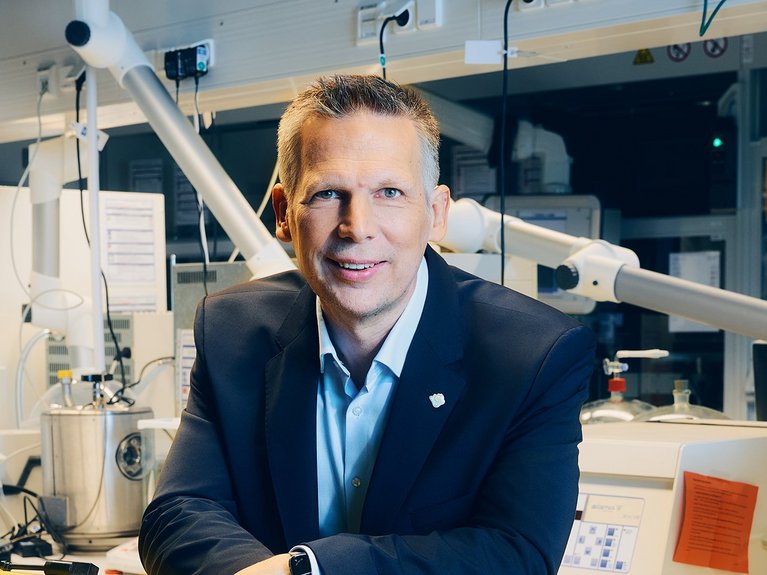
Bild: Hereon/Urban Zintel
Oliver Zielinski has been Scientific Director at Hereon since January 1, 2026. In this interview, he discusses why interdisciplinary research is so powerful and why he was immediately drawn to the center.
Professor Zielinski, how often do you get to read a fantasy novel?
[laughs] Much less than I used to. As a student, I wrote two books featuring fantasy role-playing adventures. Today, I sometimes read classics from the fantasy and science fiction genres. I recently reread The Hitchhiker’s Guide to the Galaxy, Douglas Adams’s 1979 novel. And I have to say: it is still refreshingly observant and wittily written.
Which genre would you say Hereon belongs to?
At Hereon, we consciously think about the future—and yes, that sometimes touches on what one might call science fiction. However, in my previous positions, it has always been important to me to offer technological solutions rather than fiction and to make these available to society as practical tools. This is exactly what Hereon does: we aim to shape the future by bringing together climate, coastal, and materials research and using digital twins as a tool, among other things.
How did you actually get into marine research during your physics studies?
I have always been fascinated by the mechanistic understanding of how things are interconnected. While studying computer science as a minor, I became very enthusiastic about simulating complex systems and their interactions. For my thesis, I joined a research group that used optical methods to study marine and environmental physics. My topic was initially radiative transfer modeling, but then we went out to sea—and that is how it all started.
Did you go on expeditions?
Oh yes—and they were fascinating experiences! My first expeditions took me to the subtropical North Atlantic as a doctoral researcher within an EU project. There, I realized that as a physicist, one often cannot make sufficient progress on one’s own with individual measurement methods or system-level understanding. Working with chemists, biologists, and experts from many other disciplines fascinated me so much that I transitioned from classical physics to environmental physics.
What was the focus of your work?
I worked extensively with optical measurement methods and developed some sensors myself. Over the past ten years, however, my focus has shifted: I have been working more with data. The major innovations are no longer happening in the field of new sensors, but in how we use the information we gather.
That sounds abstract. How did that manifest itself in concrete terms?
For example, I worked with long-term data from the coastal observatory on the North Sea island of Spiekeroog. We operated more than 50 different sensors measuring a wide range of environmental parameters, including currents, temperature, salinity, oxygen, and others. The challenge was that some sensors occasionally failed or delivered erroneous data. Together with computer scientists from Carl von Ossietzky University of Oldenburg, we therefore developed novel machine-learning approaches to close these data gaps. Leveraging data from the additional sensors and exploiting hidden correlations between measured variables, our methods can meaningfully reconstruct missing values. This approach can be transferred to many applications beyond environmental research.
How did that influence your research?
That was a key moment. From then on, I became more intensively involved with AI and eventually joined the German Research center for Artificial Intelligence (DFKI) while retaining my professorial position. There, I helped establish the DFKI site in Lower Saxony as Head of Research and also set up the Germany-wide Competence Center DFKI4Planet. For example, we deployed imaging sensors on drones to detect plastic waste in rivers and on beaches, and subsequently analyzed and characterized the results using our own AI tools. We then transferred this technology to several countries in Southeast Asia in collaboration with the World Bank and supported non-governmental organizations (NGOs) in Europe.
What can you take from these experiences for your new role?
Systemic thinking—and the realization of how powerful science can become when insights from one’s own discipline are further developed, linked with other bodies of knowledge, and pursued with the perseverance required to bring them to fruition. What was it that immediately fascinated me when I took a closer look at Hereon?
Well?
The perfect—probably unique—mix of expertise within a single center. There is the field of coastal and climate research, with which I was, of course, very familiar, and materials research, which excels at translating technological innovations into practice. Both are combined with a consistent focus on digital processes, which immediately captured my attention. A good example is the field of sustainable offshore wind energy: at Hereon, materials science developments for durable and resilient components are combined with environmental and system models that enable realistic predictions of the ecological impacts of offshore installations and support their integration into planning processes.
Where do you see Hereon in five years?
My vision is that Hereon will establish a clear and distinctive position in the field of digital twins of complex systems, building on its unique combination of environmental and materials research. What makes digital twins particularly powerful is that, beyond linking measurements and models, they enable deeper analysis and interaction, which can then be fed back into the real world. This effectively closes the loop.
You have worked in Rostock, Oldenburg, Bremerhaven, Wilhelmshaven, and Spiekeroog—and now in Geesthacht. Do you choose your places of work based on their proximity to the sea?
[laughs] You forgot my time at the Federal Institute of Hydrology in Koblenz! But that was really only a short stint, and obviously, the Rhine wasn't enough for me. I'm just a coastal kid: I am fascinated by the incredible dynamism that prevails where the elements of water, air, and earth interact. That's what makes this maritime environment so appealing – and shapes the people who live and work here, including those in science.
About the person: Prof. Dr. Oliver Zielinski is Scientific Director at Hereon. The physicist is an expert in marine and technology research and a professor at the University of Rostock. Most recently, he served as Director of the Leibniz Institute for Baltic Sea Research Warnemünde (IOW). Prior to that, he was Professor of Marine Sensor Systems at Carl von Ossietzky University of Oldenburg, where he also established the "Marine Perception" research area at the German Research Center for Artificial Intelligence. Zielinski was appointed to the German Council of Science and Humanities (Wissenschaftsrat, WR) in early 2025 and has been a member of the National Academy of Science and Engineering (acatech) since 2021.


Readers comments