Wearables
Magnetic sensor threads make clothing smart

Seamless navigation in a virtual environment using a knitted sleeve with integrated magnetic field sensors and a magnetic ring. Image: Free University of Bozen-Bolzano
Intelligent clothing that measures bodily functions, interacts with the environment, and can even withstand washing cycles at 30 degrees Celsius without difficulty: this is what Denys Makarov at the Helmholtz-Zentrum Dresden-Rossendorf is researching.
Denys Makarov places a thin, white cord on the table in his office at the Helmholtz-Zentrum Dresden-Rossendorf (HZDR), a few kilometers east of the Saxon capital. The cord is one to two millimeters wide, finely woven from many threads somewhat reminiscent of the spaghetti-like strand from a knitting spool. In the middle, barely visible, is a small, elongated bump only a few millimeters long. “That’s the sensor, cast in polymer and woven into the thread.” At the end of the cord, barely visible copper-colored individual wires protrude. “That’s the wiring we use to transmit the signals from the sensor and supply it with a bit of power,” says Makarov, head of the ‘Intelligent Materials and Functional Elements’ department at the Institute of Ion Beam Physics and Materials Research at HZDR. As he describes the structure, one can sense how enthusiastic he still is about its tiny dimensions: “And all of this can be produced using industrial weaving machines.”
What Makarov is presenting here is the next step in enabling people to interact with their environment via sensors. Parallel to the digitalization of recent decades, miniaturization has made it possible to integrate sensors into even smaller devices. Every smartphone contains numerous sensing elements. In addition to the light-sensitive camera sensor, there are accelerometers for spatial orientation or as spirit levels, a magnetometer used for compass functions, and a barometer for air pressure. Smartwatches integrate much of this into an even more compact form and also measure bodily signals such as blood pressure and body temperature. Much of this now even fits into smart rings, which are even smaller.
For Makarov and his colleagues, clothing is the next area for wearables, which, through sensors, allows the body to communicate with its environment. The applications could be manifold: in the professional sector, for example, for firefighters, police officers, astronauts, or even in the military, as well as in sports or in the care sector for the elderly. In any context where it may be necessary to monitor bodily functions or movements and transmit them to external points or to enable interaction, and, of course, in the realm of virtual reality, whether in games or simulations.
What makes the white thread special is that the sensor reacts to magnets. This is Makarov’s area of expertise. The researcher is originally from Ukraine but has been living in Germany for around twenty years. He earned his doctorate in physics at the University of Konstanz, specializing in magnetism. He then spent two years as a postdoc at Chemnitz University of Technology. Afterward he moved to Dresden, first to the Leibniz Institute for Solid State and Materials Research, and finally, in 2015, to the HZDR.
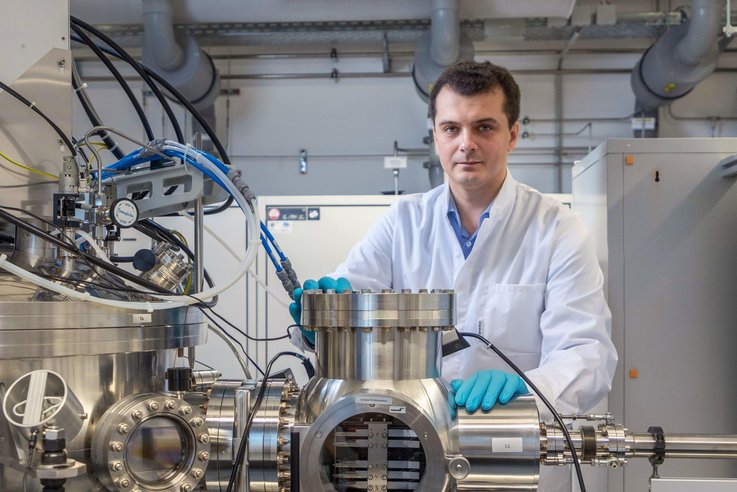
Since 2015, Dr. Denys Makarov has been conducting research at HZDR. HZDR/R. Weisflog
Magnetic sensors have an unbeatable advantage: “Signals can be triggered without touching the sensors—touchless,” he says. Tactile sensors that respond to pressure can be accidentally activated when they come into contact with the environment, such as when scraping along a wall or rolling across the floor. “This is much less likely with magnetic sensors,” says Makarov.
There are already several types of sensors that can be incorporated into fabric: conductive yarns, components printed onto the fabric, individually coated fibers, and rigid components that are attached to the fabric. However, all of these have a fundamental shortcoming: their durability is insufficient, especially for simple tasks such as washing clothes or putting on and taking off garments. It may sound mundane, but this is precisely what is required of such devices in clothing, particularly in performance clothing.
“We have now, for the first time, demonstrated that our magnetic field sensors, cast in polymer and woven into a knitted wristband, can withstand regular washing under normal conditions without damage,” explains Makarov. It can easily withstand seven wash cycles at 30 degrees Celsius and is also unaffected by humid environments or even underwater use. Moreover, the woven thread is flexible and can be stretched and pulled, just as expected from a piece of fabric. The knitted wristband, which covers the entire forearm and on which the researchers tested their technology, can be used in a variety of ways using a ring or glove that has integrated mini magnets in the fingertips. The sensors are knitted into the wristband and color-coded so that their position is clearly visible.
In spring 2025, Makarov’s Dresden-based team, primarily responsible for sensor technology, published their results in the journal Communications Engineering together with their collaborating partners at the Free University of Bozen-Bolzano and Nottingham Trent University, experts in textile technology.
But it is not yet a product, even though the research team has taken significant steps in this direction with its stress tests. One of the next important steps, says Makarov, is certification—just like for a smartwatch or a smartphone. “You have to prove that it is not dangerous, because there are electronics inside,” he explains. The problem is that there are almost no regulations for such certification. For example, consider washing: “How many wash cycles must the device withstand to demonstrate its safety and long-term stability in everyday use? There are different detergents, varying levels of water hardness, and water treatment varies across countries,” says Makarov. One almost gets the impression that developing the regulations is more complex than developing robust sensor technology woven into fabric. According to Makarov, it is important not to over-regulate: “Otherwise, no one will want to manufacture it, and the technology will die because it is too complicated.”
The Dresden-based team has therefore joined forces with twelve partners to form a consortium, including research institutions, companies, and hospitals. The goal is to develop the next steps towards commercialization and to determine which parameters are critical for proper certification. Only once this has been resolved will the magnetic sensors make their way into functional clothing worldwide.




Readers comments