Forschungshighlights
Helmholtz Annual Review 2025

Image: Michael Schmitz for Helmholtz/HIDA (CC BY-SA 4.0)
As the year draws to a close, we look back on some special events from the community. Some are surprising, others are encouraging, and still others give us pause for thought.
Neutrino mass determined with greater accuracy than ever before

Image: M. Zacher/KATRIN Collaboration
Neutrinos are among the most mysterious particles in the universe. They are omnipresent but interact with matter extremely rarely, and therefore largely remain undetected. In cosmology, they influence, among other things, how galaxies formed after the Big Bang. In supernova explosions, they slow down the collapse of large stars. The discovery that they have any mass at all came as a big surprise, because according to the Standard Model of particle physics, they are massless. The Karlsruhe Institute for Technology (KIT) is home to the world’s most precise experiment for determining neutrino mass: the large-scale research facility KATRIN. It does not measure the mass directly, but analyzes minute energy changes during the beta decay of tritium. These deviations can be used to determine the upper limit on the neutrino mass. The research team has now determined the upper limit more accurately than ever before – another piece of the puzzle on the path toward new physics.
Study provides a comprehensive overview of the extent of glacier retreat

The TanDEM-X and TerraSAR-X satellites work together to collect data for a highly accurate, three-dimensional image of our Earth with consistent quality and unprecedented accuracy. Image: DLR (CC BY-NC-ND 3.0)
Glaciers around the world are melting faster than previously thought–with far-reaching consequences for humans and the environment. Since 2000, they have lost an average of 273 billion tons of ice per year. This enormous amount not only causes sea levels to rise continuously, but also reduces the availability of freshwater in many regions. Smaller glacier regions such as Central Europe are particularly affected, with up to 39 percent of ice mass lost since the turn of the millennium. An international study provides the first comprehensive overview of glacier retreat. Coordinated by the German Aerospace Center (DLR), among others, the team analyzed large amounts of data from various satellite missions, including TanDEM-X, ICESat-2, and GRACE. Particularly striking is that ice loss has recently accelerated significantly. In the second study period, from 2012 to 2023, the annual loss rate was 36 percent higher than in previous years. The study also shows that glaciers are now the second-largest contributor to global sea-level rise, after ocean thermal expansion, ahead of the Greenland and Antarctic ice sheets. The findings provide an important data basis for climate protection and for concrete measures to adapt to the consequences of climate change.
New hope for hepatitis B: First patient receives therapeutic vaccine
TherVacB, a newly developed therapeutic vaccine against chronic hepatitis B (HBV) developed by Helmholtz Munich, is being used in a clinical trial for the first time in patients. This is an important milestone not only on the path to controlling the disease but also toward curing it. “After 13 years of intensive research, it is incredibly exciting that TherVacB is now being tested in patients for the first time. This is an important step toward a possible cure for chronic hepatitis B,” says Ulrike Protzer, inventor of the vaccine and Director of the Institute of Virology at Helmholtz Munich. TherVacB relies on a sophisticated prime-boost strategy that specifically stimulates the immune system to permanently suppress the virus. In an initial clinical trial with healthy volunteers, the vaccine has already demonstrated both safety and immunogenicity. The next step is a Phase Ib/IIa trial with 81 patients currently receiving antiviral drugs. The vaccine was developed to be effective against more than 95 percent of all HBV strains circulating worldwide. The World Health Organization estimates that more than 250 million people are chronically infected with hepatitis B, putting them at high risk of cirrhosis and liver cancer. Every year, the virus claims more than a million lives.
JUPITER: Europe’s fastest supercomputer goes into operation
Forschungszentrum Jülich. By November, it had already become the first supercomputer in Europe to exceed the 1 exaFLOP/s mark—equivalent to one quintillion calculations per second. JUPITER is also the fourth-fastest supercomputer in the world and the most energy-efficient system in the exascale class. The system thus sets a technological milestone for Europe. Even in its early operational phase, JUPITER is already delivering remarkable scientific results. In November of this year, a research team involving the Jülich Supercomputing Centre (JSC) received the prestigious “Gordon Bell Prize for Climate Modeling”, one of the most important awards in high-performance computing. The award recognized a novel approach that enables simulations of the Earth system with unprecedented spatial accuracy. In the same month, a research team from the Jülich Supercomputing Centre, together with experts from NVIDIA, set a new simulation record by simulating the behavior of a universal quantum computer with 50 qubits entirely on a classical supercomputer. Simulations of quantum computers are an indispensable tool for developing future systems. They enable the verification of results from experimental quantum computers and the testing of new quantum algorithms even before powerful quantum computers become available. These successes show that exascale supercomputers enable new classes of research questions that would be unsolvable with smaller supercomputers.
Structure of liquid carbon measured for the first time

Researchers have been able to measure liquid carbon experimentally for the first time. They combined a high-power laser with the ultrashort X-ray laser flash of the European XFEL. Image: HZDR / M. Künsting
Liquid carbon occurs inside planets and plays an important role in future technologies such as nuclear fusion. Until now, however, very little was known about carbon in liquid form, as this state was virtually impossible to achieve in the laboratory: at normal pressure, carbon does not melt but transitions directly into a gaseous state. Only under extreme pressure and at temperatures of around 4,500 degrees Celsius—the highest melting point of any material—does carbon become liquid. No container could withstand these conditions. At the European XFEL in Schenefeld near Hamburg, the world's largest X-ray laser with its ultrashort pulses, an international research team led by the University of Rostock and the Helmholtz-Zentrum Dresden-Rossendorf (HZDR) has succeeded in liquefying carbon for fractions of a second. In the experiment, short, high-energy laser pulses liquefied carbon for a few nanoseconds, which were then used to produce ultrafast X-ray images. This enabled visualization of the atomic arrangement in this extreme state for the first time. The results show a water-like structure with four neighboring atoms–confirming theoretical models. In addition to providing fundamental insights for planetary research, the data could also be crucial for the further development of nuclear fusion.
Initiative to preserve US research datasets

Image: AWI/Esther Horvath
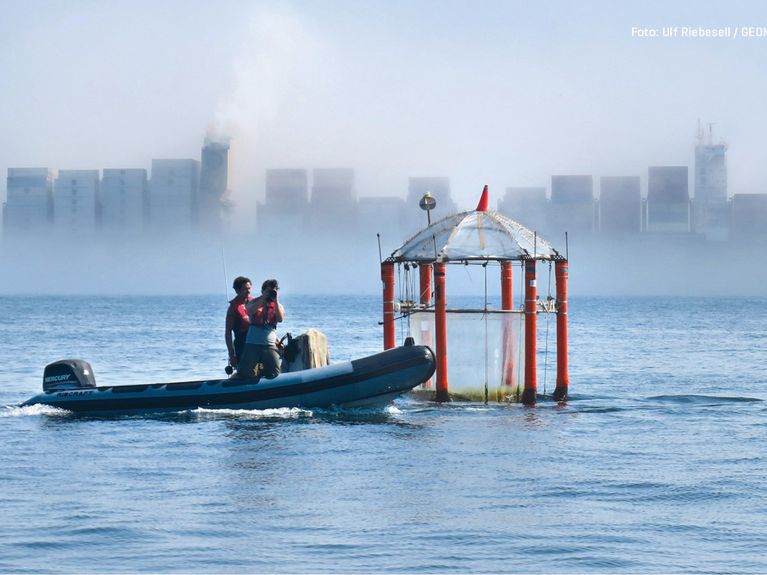
Budget cuts at the National Oceanic and Atmospheric Administration (NOAA), the US weather and oceanography agency, could lead to a lack of relevant knowledge needed to combat global challenges such as climate change in the future. No other country is as important to the global scientific data infrastructure as the United States. Through its influence, the Trump administration threatens to deprive researchers worldwide of a central foundation for their work. Against this backdrop, the Alfred Wegener Institute, Helmholtz Centre for Polar and Marine Research, together with the University of Bremen, sent an important signal for the preservation of scientific foundations: for the first time, scientific datasets from the US were secured via the PANGAEA data platform. The first step was to secure historical datasets on earthquakes and hot springs. The aim of the initiative is not only to secure endangered data collections in the short term but also to integrate them permanently into PANGAEA's open infrastructure, thus making them accessible worldwide.
AI model predicts disease risks decades in advance

Image: Greenbutterfly/Shutterstock
An international research team led by the European Molecular Biology Laboratory (EMBL) and the German Cancer Research Center (DKFZ) has developed a generative AI model that can assess the risk of more than 1,000 diseases individually and over the long term. The model, trained and tested on anonymized medical data from the UK and Denmark, can predict health events over more than a decade. It was trained using anonymized health data from 2.3 million people in the UK and Denmark. As with language models, the AI analyzes the chronological sequence of medical events to identify patterns and predict future disease progression—such as the risk of a heart attack in certain age groups. The system does not work with certainties but with probabilities, like weather forecasts. The model is particularly reliable for common chronic widespread diseases such as diabetes or cardiovascular disease, but it has its limitations when it comes to rare or infectious diseases. It has not yet been approved for clinical use, but it offers enormous potential for personalized prevention and proactive health planning. The researchers emphasize that all data were processed in accordance with strict ethical standards, including the use of secure servers, compliance with national data protection rules, and voluntary consent. In the long term, such AI models could help healthcare systems worldwide to take preventive action, identify risks early, and tailor treatments more individually.
The course has been set for the construction of PETRA IV
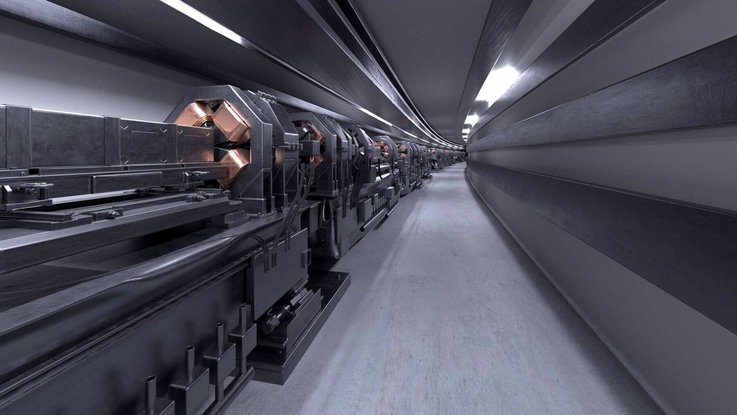
Der Blick in den neuen Tunnel in einer grafischen Darstellung. Bild: DESY/Science Communication Lab
Advances in health, environmental technology, and microelectronics often depend on our understanding of materials. To penetrate the smallest regions, large-scale research infrastructures are required. At the German Electron Synchrotron (DESY) in Hamburg, the large-scale research facility PETRA IV is to be built, the most powerful X-ray microscope of its kind, which makes structures and processes visible down to the atomic level. It is being developed as a further refinement of PETRA III and uses synchrotron radiation with extremely low emittance. PETRA IV will be many times more brilliant, precise, and faster than PETRA III and will also be able to “film” nanoscopic structural changes. Around 20 percent of the measurement time is reserved for industrial partners. "Having such a brilliant X-ray light source in our own country means independence: not having to wait for experimental opportunities on other continents and having unrestricted, exclusive access to the data obtained," explains Beate Heinemann. This aspect is particularly important for Europe in competition with the US and China. In addition, the Federal Ministry of Education and Research (BMBF) has set the course for further large-scale projects this year. In addition to PETRA IV, three other Helmholtz projects are on the shortlist for promising large-scale research facilities. DALI – Dresden Advanced Light Infrastructure is to be built at the Helmholtz-Zentrum Dresden-Rossendorf (HZDR). This ultra-fast pulsed light source enables the experimental recording of complex dynamic processes. The HBS-I neutron source is being built at Forschungszentrum Jülich. Also on the shortlist is IceCube Gen2, an observatory that can detect ultrahigh-energy neutrinos from distant cosmic events.
SOLAR Tap: A successful model for technology transfer

Flexible solar modules. Image: Solar TAP/Stefanie Ditze
Printed, ultra-lightweight, and flexible solar modules that can be freely shaped and integrated into agriculture, building envelopes, or mobile systems represent a promising technology. The SOLAR Tap innovation platform accelerates the development of this technology and provides companies with rapid access to high-end research infrastructure that is usually reserved for large research institutions–including roll-to-roll pilot plants, advanced printing technologies, and digital twins. This enables companies to test prototypes, new materials, or entire manufacturing steps under realistic conditions and bring them to market more quickly. The innovation platform focuses on printed, ultra-lightweight, and flexible solar modules that can be freely shaped and integrated into agriculture, building envelopes, or mobile systems, for example. SOLAR Tap is supported by three Helmholtz Centres: Forschungszentrum Jülich, Helmholtz-Zentrum Berlin, and the Karlsruhe Institute of Technology. Together, they combine their facilities and expertise to form an innovation ecosystem that is unique in Europe. Since 2023, SOLAR Tap has developed into a central hub for cooperation between research and industry: it now includes more than 50 companies–from start-ups to global market leaders, including virtually all major manufacturers of innovative solar cells that are not yet commercially established. In addition, more than 60 companies are now cooperating with the platform on research projects.
Therapy and imaging in one: Radioactive ion beams open up new avenues in cancer treatment

Project manager Marco Durante with part of his team. Image: J. Hosan, GSI/FAIR
Radiation therapy is one of the central pillars in the treatment of cancer. While conventional radiation with photons often damages healthy tissue, irradiation with charged particles, such as protons or heavy ions, allows for much more precise dosing: the particles deposit their energy specifically in the tumor, while sparing surrounding structures. Ion beams—especially carbon ions—can also destroy radiation-resistant tumor cells more efficiently. An interdisciplinary research team at the GSI Helmholtz Centre for Heavy Ion Research, together with FAIR (Facility for Antiproton and Ion Research), has, for the first time, demonstrated the treatment of a tumor in an animal using radioactive ion beams. The published work focuses on the pioneering idea of using radioactive ion beams simultaneously for treatment and imaging during therapy. This approach was made possible by the high beam intensity generated by researchers at the GSI/FAIR accelerator facility. In the study, osteosarcoma in a mouse was precisely destroyed with a ¹¹C carbon ion beam—without neurological side effects. A specially developed PET scanner from LMU Munich enabled real-time, accurate tracking of radiation in the body. The interdisciplinary project team collaborated internationally, including with LMU and a Japanese research laboratory. The results show that image-guided radiation therapy with radioactive ion beams is feasible, safe, and effective. They mark a significant step toward the clinical application of this innovative form of therapy.


Readers comments