Software for automated product development
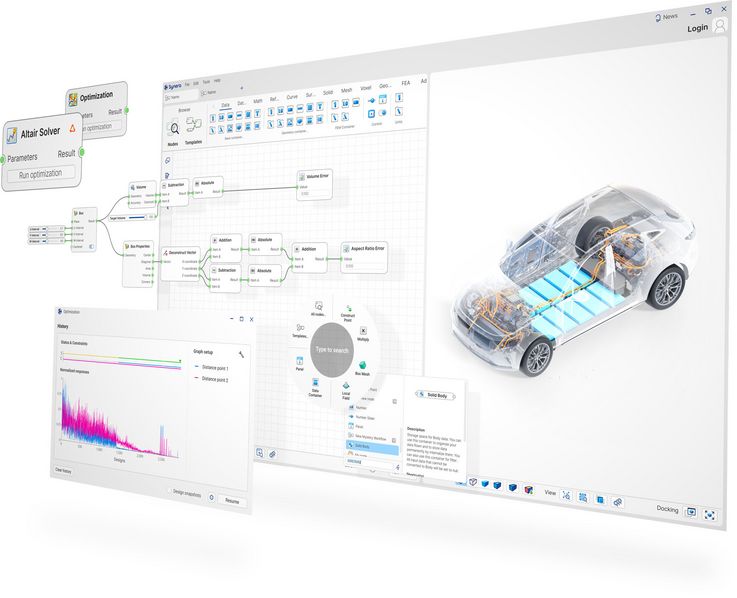
Image: Synera
The Challenge
The development departments of technology companies are currently under considerable pressure, as expectations to deliver innovative products within increasingly shorter time frames continue to rise. At the same time, however, the components required for this are becoming increasingly complex, for example, because they must be digitally controllable, incorporate innovative materials, or comply with climate protection requirements. Engineers in product development are therefore struggling with very tight time budgets. They spend around 80 percent of their working day on repetitive routine tasks. This situation is because the design process in mechanical engineering is still largely unautomated: each component is designed, constructed, and tested from scratch, usually by different departments within a company. These departments typically do not employ standardized software. This lack of standardization repeatedly leads to misunderstandings, errors, or unnecessary delays. As a result, it can take many months or even years for new technical products to reach the market.
Our Solution
A spin-off of the Alfred Wegener Institute, Helmholtz Centre for Polar and Marine Research (AWI), has developed software that automates the product development process. The program consolidates the knowledge of all employees involved, including raw material prices, existing product tests, and the environmental compatibility of individual materials. It also links the individual steps in product development using low-code: the system displays work orders on the screen as graphical elements that users can connect with a single click. Algorithms run in the background, and no in-depth programming knowledge is required. With the involvement of all stakeholders, the program gradually generates an optimal development process tailored to a company's specific needs. If a detail changes, whether it concerns the dimensions of a component, the price of a material, or the material itself, the software automatically calculates how the data changes across the entire process path. This approach significantly accelerates product development, and initial users have reported an increase of up to 76 percent.
The Bremen-based company Synera (formerly Elise), a spin-off of AWI that has been active since 2018, developed the platform. The start-up builds on years of basic and applied research conducted by the AWI's Bionic Lightweight Construction working group, led by Christian Hamm.
How are we already benefiting from it today
Numerous companies in the automotive, aviation, and aerospace industries already use Synera's automation software, including Airbus, VW, and MAN. Since 2024, NASA has also been relying on the program. The companies report high cost and time savings. Reflex Aerospace, a satellite manufacturer, was able to reduce its design and delivery times by 75 percent in selected projects. To further reduce the workload on engineers, Synera also offers AI agents that take on time-consuming tasks such as design adjustments or iterative mechanical analyses and can operate continuously if necessary, thereby accelerating product development. Engineers can provide these agents with their expertise, for example, and then entrust them with specific design or testing tasks. If several agents are linked together, they are also capable of collaborative operation. This approach is helpful, for example, when calculating costs for a bid, as the various departments within a company perform design and simulation work to provide cost estimates. Project managers must then calculate the total cost. Interconnected AI agents deliver such data within minutes.
The design tools also help companies use materials more sustainably: engineers can use them to test how lightweight they can make their designs without compromising their stability, for example. Such components save CO₂ because they use less material. Since the program oversees the entire development process of a product, it can also provide information on the reusability of materials or their supply chains. In this way, the software ensures designs that are not only innovative but also efficient and environmentally friendly.