Platform technology for innovative, energy-saving computer chips
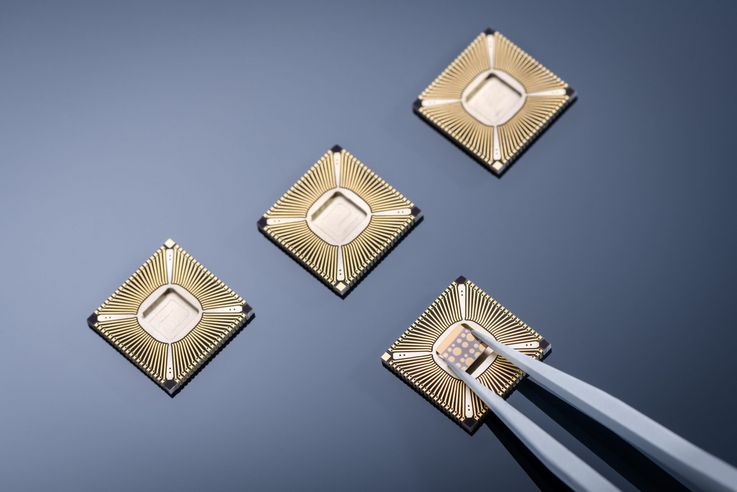
Chip carrier with memristor components. Image: Frische Fische / TECHiFAB
The Challenge
The demand for powerful computer chips is growing rapidly, partly because companies worldwide are increasingly relying on AI. However, these applications consume a lot of energy: experts expect that this will triple the power consumption of data centers in Europe alone by 2030. At the same time, the chips themselves are reaching the limits of their performance: the transistors installed on them can no longer miniaturize further indefinitely. Additionally, they process data relatively slowly because the information on conventional chips must first flow from memory to the processor and back again. This constant flow of data costs time and energy. To fully exploit the potential of innovative digital applications such as AI, we therefore need a completely new type of chip: it must be faster and more energy-efficient than today's models.
The Solution
Our brain is far superior to supercomputers in terms of efficiency: it processes information in fractions of a second and consumes very little energy in the process. One reason for this is the organ's unique mode of operation: it processes and stores information in the same place, in the neurons. Researchers at the Helmholtz-Zentrum Dresden-Rossendorf (HZDR) are mimicking this principle: they have developed a platform technology for reconfigurable, analog electronic components that enables the construction of computer chips to perform complex computing tasks with minimal energy consumption. These electronic components function similarly to synapses, i.e., the nerve connections in the brain that form and strengthen with repeated activation. TiF components are also physically capable of remembering which electronic signals they have processed in the past. They can therefore perform calculations directly, eliminating the need for constant data exchange between memory and processor.
This architecture reduces energy consumption and speeds up analysis: TiF components deliver their results within fractions of a second. This capability is particularly relevant for applications that rely on real-time data, such as robotics or autonomous driving. Because the novel chips store and process information locally, they can also function without cloud services when necessary. This feature is particularly relevant for sensitive data, which is thus better protected against unwanted external access. Researchers have been searching for suitable materials for reconfigurable components for five decades. At HZDR in 2011, physicist Heidemarie Krüger and her team discovered a powerful material combination for TiF platform technology: a combination of iron oxide and bismuth oxide.
How are we already benefiting from it today
The first computer chips that work with this material mix have been available since 2024 from the Dresden-based start-up TECHiFAB, a spin-off of the HZDR. Computer chips with TiF components have the potential to save up to 90 percent of the energy required and process data 400 times faster than previous systems. Heidemarie Krüger, who now works at the Leibniz Institute of Photonic Technology and as a professor at Friedrich Schiller University in Jena, aims to gain initial practical experience with industrial companies by using the first chips based on this platform. In steel mills, for example, TECHiFAB models are already being tested to determine whether the rollers are functioning properly. They can also support bridge maintenance. However, they may Plattformtechnologie für neuartige, energiesparende Computerchipsalso find applications in numerous other industries, such as the automotive industry, mechanical engineering, and medical technology. The German Federal Agency for Breakthrough Innovations (SPRIND) is supporting TECHiFAB with a multi-million euro grant.
Further reading: