ISPTech: Green propulsion systems for space
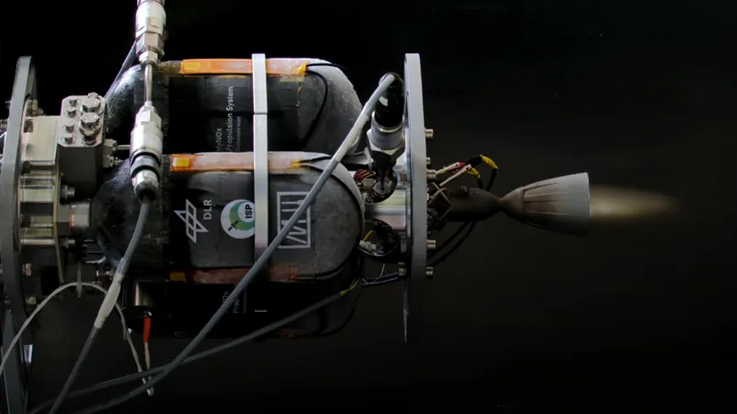
SmallSat Propulsion Demonstrator 22N Thruster. Image: ISPTech
The Challenge
Spacecraft have to maneuver more and more frequently in space, for example, to respond to the ever-growing number of satellites and to avoid space debris. To achieve this, spacecraft require reliable propulsion systems that continue to rely on proven but highly problematic fuels such as hydrazine, a propellant used in satellites and space probes. However, the liquid is so toxic and carcinogenic that personnel must wear special protective suits with their own air supply when handling it. This requirement makes every refueling process complex and expensive.
Our Solution
The German Aerospace Center (DLR) has been conducting research into environmentally friendly alternatives to hydrazine for many years. These alternatives should be non-toxic and easier to handle. Two new fuels are particularly promising: HyNOx and HIP-11, developed at the DLR Institute of Space Propulsion in Lampoldshausen. HyNOx is particularly suitable for small satellites. It is non-toxic, easy to handle, readily available, and inexpensive. Its components are nitrous oxide and ethane. HIP-11 performs similarly to hydrazine but is significantly less toxic; it involves a reaction between hydrogen peroxide and a liquid salt. The fuel is particularly suitable for larger spacecraft such as capsules or landers. What makes it unique is the wide range of applications for which it can be used: depending on requirements, it can deliver high thrust, for example, while also enabling sensitive maneuvering. It is also possible to switch between the different modes as required. This property makes HyNOx and HIP-11 significantly superior to other environmentally friendly fuels. However, the fuels alone cannot power a spacecraft. Such a system requires a propulsion system consisting of a control unit, tanks containing the fuels, pipes, valves, and rocket engines that provide the thrust. DLR has also begun developing engines for the new fuels.
How are we already benefiting from it today
To put these two innovative technologies into practice, their developers, Lukas Werling and Felix Lauck, founded the start-up ISPTech (InSpacePropulsion Technologies) in 2023. The company markets propulsion systems for spacecraft that run on HyNOx and HIP-11. The start-up is currently testing its products under simulated space conditions, and the first products are scheduled for delivery shortly. The system is due for its first deployment in space in the second half of 2026. There is strong interest in both fuels, and the start-up has already secured its first customers in the aerospace industry and the research community.