Drug for metastatic prostate cancer
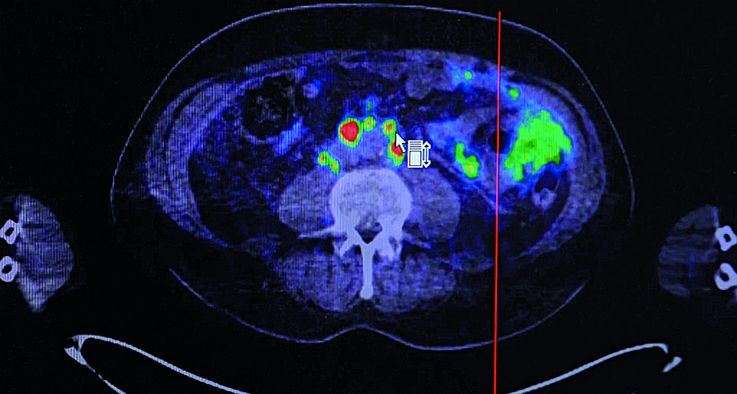
A combined PET/CT scan showing cancer metastases. Image: Film for the 2018 Erwin Schrödinger Prize / fact+film
The Challenge
Prostate cancer is the most common cancer among men in Germany. Approximately 70,000 new cases are registered each year. If only the prostate itself is affected, the survival chances for patients during the first five years are high. However, survival rates decline sharply if the tumor has already formed metastases. The disease is therefore the second leading cause of cancer-related deaths among German men.
The Therapy
Scientists at the German Cancer Research Center (DKFZ), in collaboration with Heidelberg University Hospital and Heidelberg University, have developed a new drug for metastatic prostate cancer: Lutetium-177-PSMA-617. The drug releases radioactive radiation over a very short distance within the body. At the same time, it targets cancer cells with great precision. Both of these properties ensure that healthy tissue is less affected during therapy with Lutetium-177-PSMA-617.
This mechanism is made possible by the drug’s unique structure, which consists of two components. Lutetium-177 is responsible for the emitted radiation, while PSMA-617 functions as a targeting ligand that directs lutetium into cancer cells. The small molecule binds to the prostate-specific membrane antigen (PSMA) on the surface of cancer cells. PSMA is a protein that is expressed at significantly higher levels on the surface of prostate cancer cells than on healthy cells. In therapy with Lutetium-177-PSMA-617, therefore, primarily diseased cells take up the radioactive agent. There, it accumulates and releases its cell-killing radiation dose. Studies show that this treatment can slow the progression of the disease by several months.
How are we already benefiting from it today
Lutetium-177-PSMA-617 has been approved in Europe and the United States under the trade name Pluvicto® since 2022. The pharmaceutical company Novartis manufactures the drug. Several studies have since confirmed its effectiveness in patients with advanced-stage disease. Initial scientific findings suggest that Pluvicto® may be effective at earlier stages of the disease. In the United States, the drug was therefore already approved for an expanded indication. In Europe, another therapy for metastatic prostate cancer has now also received approval.
A new drug for metastatic prostate cancer recently received approval in Europe.