Compact plants for the production of e-fuels
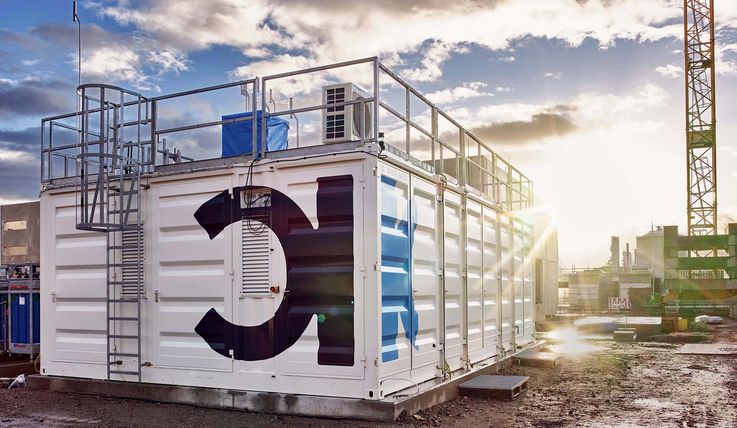
Module of the pilot plant in Frankfurt. Image: INERATEC
The Challenge
There is still a lack of alternatives to conventional fossil fuels in the transport sector: electric drives are likely to prevail only in road transport. However, they are not suitable for large ships and aircraft. Most freighters and airlines, therefore, continue to use petroleum-based fuels. These release large quantities of climate-damaging gases when burned. Shipping and air traffic each contribute three percent to global emissions. E-fuels—synthetic fuels produced from hydrogen generated using renewable electricity and CO₂—could provide a viable solution. However, their production is complex and still in the development stage. Achieving the climate transition in the mobility sector, therefore, requires optimizing these processes to ensure market viability.
Our Solution
Researchers at the Karlsruhe Institute of Technology (KIT) have developed a particularly efficient technology for producing synthetic fuels. The reactor is 80 times more compact than conventional reactors. This development enabled the installation of the first production plant for manufacturing sustainable fuels in a conventional shipping container. INERATEC, a spin-off of the Karlsruhe Institute of Technology (KIT), subsequently commercialized and further developed the technology. Due to the scaling of capacity, the plants today are usually composed of several such containers. This modular approach is unique worldwide and offers numerous advantages.
Thanks to INERATEC's innovative synthesis technology, it has been possible to standardize the individual plant units, enabling them to be manufactured centrally and then delivered. The plants can operate wherever renewable electricity and CO₂ are available. The global availability of such locations provides INERATEC's innovation with significant potential for climate change mitigation. Modular e-fuel units are typically deployed at biogas plants or near solar parks. There, the fuels could also serve as an energy storage medium: if, for example, the solar park supplies more energy than is currently being used, the surplus can be used for the production of synthetic fuel. Their design and technology also allow the plants to operate flexibly. Depending on feedstock availability (CO₂ and renewable electricity or water), individual modules of the plant complex can be activated or deactivated.
How are we already benefiting from it today
INERATEC is currently building the world's largest commercial plant for producing e-fuels in the Frankfurt Höchst industrial park. It can produce up to 2,500 tons of renewable e-fuels per year - including, for example, e-SAF, or sustainable kerosene. INERATEC is also expanding its activities internationally. The company, co-founded in 2016 by chemical engineer Tim Böltken at KIT, is now regarded as the world's leading provider of e-fuel solutions. In addition to the pioneering plant in Frankfurt Höchst, further and larger plants are planned in Chile and southern France, for example, where INERATEC will produce sustainable fuels. Chile is a particularly promising location, as renewable electricity and CO₂ are readily available there. In addition, INERATEC has already established several strategic partnerships along the value chain in Chile, which will drive the expansion of e-fuel production capacity.
Further reading: