AI platform for materials researchers
The Challenge
New, innovative materials are key to many future technologies. The energy sector, for example, requires them to manufacture solar panels that operate more efficiently than today's models. Battery manufacturers are also seeking alternative raw materials, for instance, for high-performance batteries in electric cars. One reason for this is that lithium-ion batteries currently in widespread use rely on materials whose extraction can have a significant environmental impact. Examples such as these show that novel, sustainable materials are not only crucial to the success of the energy transition but also help companies to comply with environmental and climate standards. However, developing such materials is an enormous challenge. Research is often based primarily on laboratory tests, which makes the process slow and resource-intensive. As a result, it usually takes many years, or even decades, for new materials to reach market maturity – a test of patience that slows down technological progress.
Our Solution
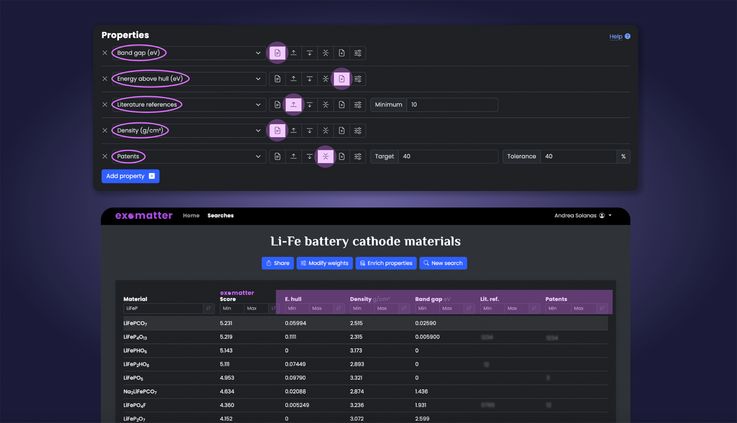
Artificial intelligence accelerates the development of new materials by opening up completely new perspectives in research and significantly reducing the experimental phase. ExoMatter, a spin-off of the German Aerospace Center (DLR), offers this capability through its Platform for Materials R&D. The platform uses data mining and machine learning to provide information on over 1.5 million materials. The sources are scientific material databases from around the world. Users can use a search interface to specify exactly what requirements they have for the desired material. For example, should it be fireproof or water-soluble, particularly robust or lightweight? The platform then displays suitable materials and also provides information about their price, availability, carbon footprint, and any existing patents. These still need to be tested in the lab, but the AI narrows down the number of potential candidates in advance, making the search more focused, which significantly speeds up the development process. In initial projects, the cost and time required for companies fell by up to 90 percent. ExoMatter also aims to make this AI-supported material knowledge easily accessible. The platform's interface enables employees with limited prior expertise to use the system. This accessibility is particularly relevant for smaller companies that do not employ dedicated AI or materials experts.
How are we already benefiting from it today
The first companies have already begun working with the platform, including large corporations such as Audi, Airbus, and Infineon, as well as several medium-sized companies. ExoMatter currently focuses on inorganic solids, but its range of services continues to expand. The company aims to establish its system as the standard for discovering innovative and sustainable materials. Companies book the service on an annual subscription basis.