A surgical robot arm from space research
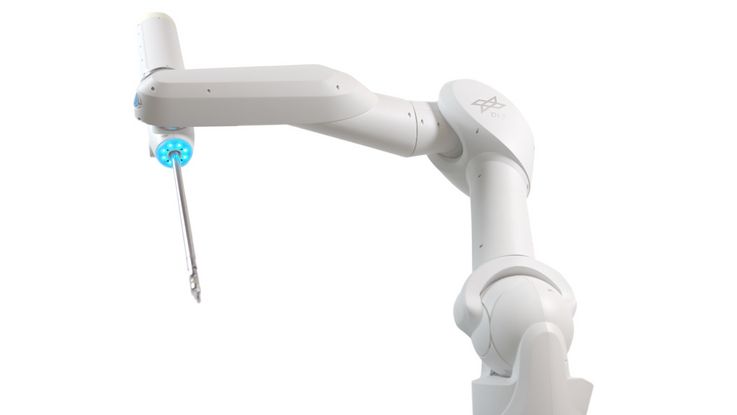
Image: DLR (CC BY-NC-ND 3.0)
The Challenge
Surgical procedures are safer today than ever before. Yet they still present challenges: Areas of the body that are difficult to access can sometimes only be reached by making larger incisions. However, these incisions heal poorly in some patients. In such cases, doctors must operate for extended periods in strenuous positions, which can sometimes lead to imprecise handling of surgical instruments.
Our Solution
Help comes from space research: The German Aerospace Center (DLR) has developed a robotic arm that resembles the human arm in terms of structure, size, and mobility. It can grasp objects delicately and guide instruments with precision. The system operates under manual control. Originally, the arm served to carry out repairs in space, for example, on the outer skin of space stations. However, the researchers involved at the DLR Institute of Robotics and Mechatronics quickly discovered the system's potential for medicine and designed a specialized robotic arm, MIRO. It supports surgical teams in minimally invasive procedures. Surgeons control it from a console in the operating room, with a screen that displays endoscopic images in 3D. The robot's surgical instruments act as an extension of the surgeon's arm, allowing them to work safely, with focus and precision, even in areas of the body that are difficult to access. Because MIRO's delicate instruments require only small incisions, the risk of complications for patients is reduced.
How are we already benefiting from it today
Studies have already tested the use of MIRO in numerous medical fields, for example, in orthopedics, where it cuts bone material with a laser and inserts screws for prostheses. The robotic arm also takes tissue samples and sutures wounds. For complex procedures, surgeons can combine two or more robotic arms, and the MiroSurge system, also developed by DLR, ensures smooth collaboration between medical professionals and devices.
Based on this, the company Medtronic has developed the Hugo™-RAS surgical robot. Compared to other surgical robots, it offers the advantage that its console can be placed directly on the operating table, allowing users to maintain visual contact with the patient or the rest of the surgical team at any time if necessary. In other models on the market, the screen that surgeons work on during the procedure is more shielded. Furthermore, Hugo does not use permanently integrated arms; instead, the system's modular design allows each arm to be positioned as needed, with each arm mounted on its own mobile frame. In 2013, the DLR licensed the technical components of MIRO to Medtronic, one of the world's largest manufacturers of medical technology. The company continued to develop the system over several years, and in 2021, Hugo received approval for the European market, with approval in the US imminent. By 2024, 48 of the devices were in use in Europe. Of these, five were in use in Germany. Market launch in the US is scheduled for 2026, pending approval.