A laboratory-developed eco-friendly alternative to shrimp
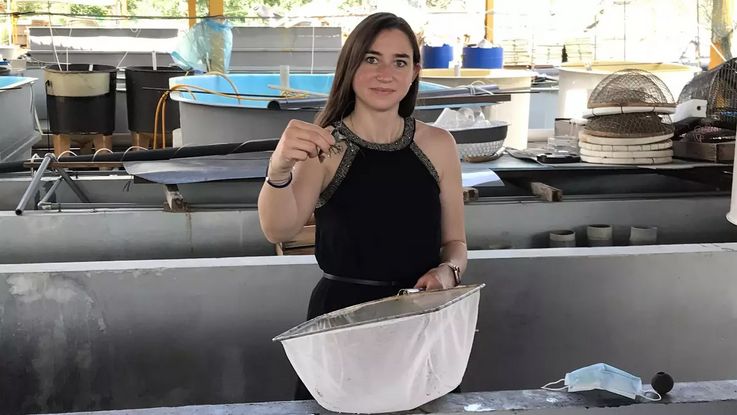
Sina Tönges of the German Cancer Research Center (DKFZ) with a marbled crayfish. Image: Frank Lyko
The Challenge
Shrimp farming in open aquaculture systems, which is currently the dominant practice in Southeast Asia, poses significant environmental challenges. These farms often disrupt the ecological balance of nearby natural water bodies. This problem partly results from the removal of mangrove forests to establish these farms. Additionally, shrimp feed often contains hormones and medications, which can subsequently leach into the surrounding environment. In addition, wastewater from these facilities is frequently discharged into the environment unfiltered and contains high levels of harmful nitrogen due to feed residues and animal excrement. In many places, working conditions on these farms are also considered appalling. Shrimp caught in Europe also pose problems: fishermen typically use trawl nets, a fishing method that damages marine ecosystems. The catch is then usually transported to North Africa for processing, and from there the shrimp meat is shipped back to Europe for sale. These transport processes emit significant amounts of CO₂. At the same time, crustaceans are an important food source. Furthermore, the animals’ shells provide an important raw material for bioplastics: chitin.
Our Solution
A far less problematic alternative to shrimp for the food and plastics industries originates from medical cancer research. At the German Cancer Research Center (DKFZ), biologist Frank Lyko and his team have established a colony of marbled crayfish. These crayfish have only been known since the 1990s and originated in a private German aquarium, where the owner had purchased American crayfish. A spontaneous genetic mutation is assumed to have occurred in one of these animals. The resulting marbled crayfish reproduces at a very high rate. These animals are of interest to researchers at the DKFZ because they reproduce through parthenogenesis, effectively cloning themselves. In their research, scientists found that this species is particularly undemanding and well-suited to closed-loop aquaculture systems.
The company Merall Bio, a spin-off of the DKFZ, has developed such a system. It plans to use this system to farm marbled crayfish and utilize the animals holistically. Their meat serves as food, and their shells provide chitin. Compared with other farmed animals, their feed conversion ratio is highly efficient: they require only 1.4 kilograms of feed for every kilogram of growth. By comparison, cattle require approximately six times as much feed. Marbled crayfish meat also has a high nutritional value. It contains approximately 16% protein and only 0.3% fat. The animals’ shells yield three times as much chitin as shrimp exoskeletons. In addition, the shells contain other valuable substances, such as astaxanthin, a natural red pigment used in food and animal feed that is in high demand.
Merall Bio keeps the animals in closed biofloc systems. These systems consume very little water and energy due to a symbiotic relationship between bacteria, algae, and the crayfish. This symbiosis contributes to water purification and improves feed efficiency. It also enables continuous monitoring of water quality. As a result, the use of antibiotics in breeding is no longer necessary. Because the facilities are self-contained, there is no contact with natural water bodies. This aspect is particularly important because marbled crayfish are considered an invasive species.
How are we already benefiting from it today
Merall Bio has already developed prototypes of its farming facilities. The startup now aims to establish a small-scale production line and prepare for the market launch of crayfish meat. In the future, the company plans to market it similarly to peeled crab meat. Additionally, the company processes the animals’ shells into bioplastic materials. To achieve this, Merall Bio has built its own biorefinery. It operates in a significantly more environmentally friendly manner than comparable facilities in Southeast Asia, which rely on caustic soda and hydrochloric acid. The company has already developed its first bioplastic product, namely drinking straws. However, this represents only the beginning. Crayfish-derived chitin is suitable for applications including food packaging, agriculture, and construction.