Biomaterials
When the body repairs itself
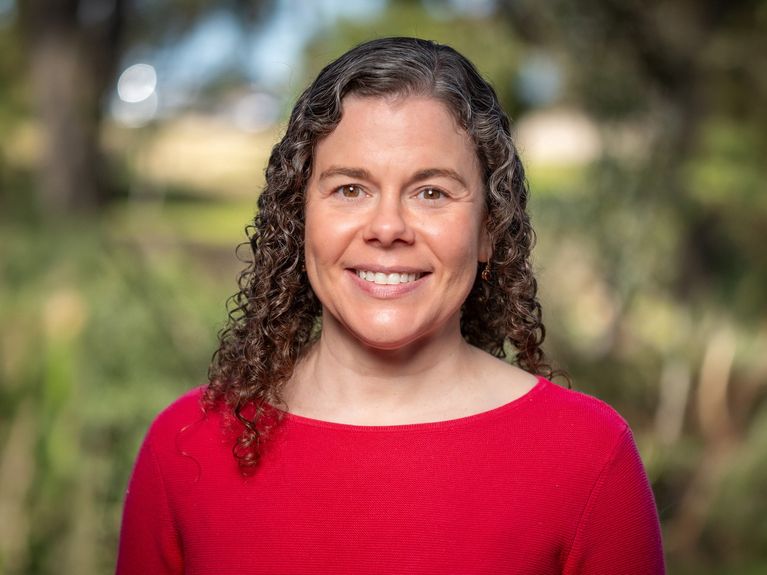
Bild: David Baillot
American biomedical scientist Karen Christman is a pioneer in the field of biomaterials. The substances she develops in the laboratory can repair damaged heart tissue directly within the body, opening up new avenues for treatment. Having received the Humboldt Research Award, she is now conducting research at the Max Delbrück Center in Berlin.
If she hadn’t played volleyball in her youth, things might have turned out differently. Then Karen Christman wouldn’t have enrolled at Northwestern University in Illinois, which started her journey in becoming a pioneer in the field of biomaterials. The discoveries from her lab have the potential to revolutionize medicine—and she will now take important steps in this direction at the Max Delbrück Center in Berlin as well. “Back then, I played in the back row,” says Karen Christman. “I loved the sport in high school so I looked for a university that was academically top-tier and where I could also continue to play volleyball at a high level.” And so, to pursue her studies, she relocated from her home in Texas to Illinois.
Those were exciting years in her field—biomedical engineering—just before the turn of the millennium, and she knew right away that she was in the right place when she first saw the course catalog. “On the list of courses, I saw mathematics, biology, chemistry, and physiology,” she recalls, “a combination of everything I loved.” Her upbringing likely played a small part in this decision; her mother was previously a math teacher, and her father holds a doctorate in nuclear engineering. Karen Christman decided to study biomedical engineering, and because biomaterials in cardiology hadn’t been studied for promoting regeneration at the time, she soon specialized in this field. The fact that such biomaterials are now considered a promising approach in the treatment of a wide variety of heart diseases, including myocardial infarction, is also due to the work that Karen Christman and her team have done since then.
“There are several schools of thought in the field of biomaterials for regenerative medicine,” explains the researcher, who is now conducting research at the University of California San Diego. “Some grow artificial tissue outside the body and then implant it. We take a different approach.” In so-called in situ tissue engineering, a biomaterial is developed for injection into the patient, where it acts directly within the body to promote the regeneration of the required tissue. In her case, this biomaterial consists of an extracellular matrix obtained by chemical processing of animal tissue. This material is similar in composition to the natural environment of the body’s cells and is therefore well accepted. In the body, it acts as a scaffold that stimulates tissue healing. This approach is less costly, faster, and, above all, spares patients from complex surgeries, Karen Christman explains.
She achieved her first breakthrough with a hydrogel for the treatment of myocardial infarction. During a myocardial infarction, heart tissue dies due to a lack of blood flow; the heart no longer pumps effectively. The liquid hydrogel is delivered directly into the heart via a catheter, allowing it to reach the target site immediately. The cells in the body respond to this material by attaching to it and initiating repair processes. This gel is already in clinical trials. For Karen Christman, cardiovascular research is also a personal cause: “Both of my grandfathers,” she says, “died of heart attacks.”
This hydrogel is will also be tested soon in two new clinical trials: one focuses on stimulating new blood vessel formation to augment bypass surgery. The second concerns the treatment of a congenital heart defect known as hypoplastic left heart syndrome. In this condition, the left ventricle is too small. “Our approach is not aimed at altering this undersized ventricle. We want to improve function of the right ventricle, which is under stress because it has to do the job of the left ventricle and pump blood to the entire body.” Biomaterials can help here as well.
Karen Christman has been collaborating with researchers in Germany for some time. She is a Visiting Fellow of the Charité Foundation at the Max Delbrück Center (MDC) and has now received the Humboldt Research Award. The award is part of the 1000-Köpfe-plus program of the German Federal Ministry of Education and Research (BMBF), which aims to attract outstanding international scientific talent to Germany. “I keep coming back to Germany to conduct research—this summer, I plan to spend three consecutive months in Berlin,” she says. At the MDC, she is collaborating with other scientists to use methods of spatial transcriptomics, which are molecular biological methods that allow her to analyze gene expression in tissues directly within their spatial context. “Thus, we will observe not only which genes are active, but also where exactly within tissues they are active,” she explains. She hopes this will lead to further decisive breakthroughs in her research on biomaterials.
Over the years, Karen Christman and her research group in California have filed more than 20 patents. She says she no longer has time to play volleyball. Instead, she goes hiking and cycling. She laughs and says that this did not play a role in her decision to move to Berlin, but she is already looking forward to using the cycling paths around Berlin when she comes to Europe for an extended stay this summer.


Readers comments