One of 48,000
Three questions for mechanical engineer Ramla Najjar
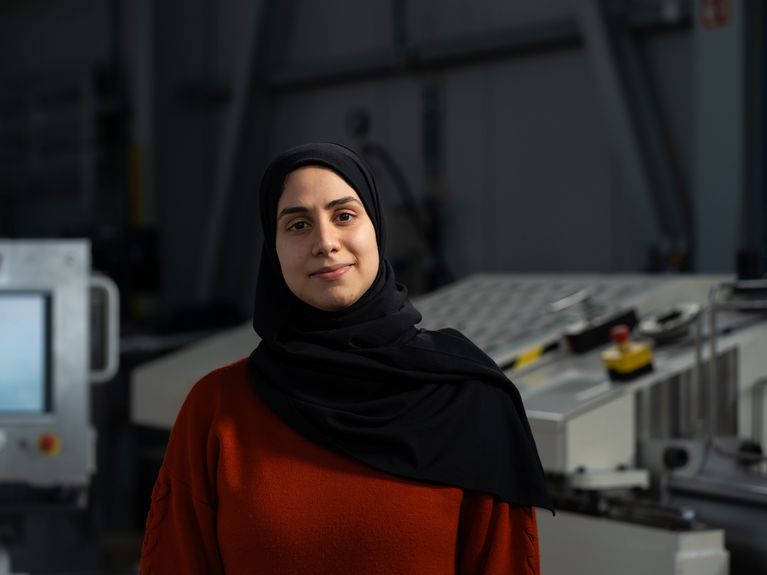
Image: Helmholtz-Zentrum Hereon/Jewgeni Roppel
Ramla Najjar is a mechanical engineer and doctoral researcher at the Helmholtz-Zentrum Hereon’s Institute of Material and Process Design. She is also one of the center’s Ph.D. student representatives.
What is the most exciting thing about your job?
I think that the most exciting part of my work is turning physical phenomena into something computable and then using those computations to uncover behaviors that would be impossible to observe directly. As a doctoral researcher in mechanical engineering, with a focus on numerical simulations and machine learning, I work at the intersection of physics, mathematics, and data science. Whether I’m conducting experiments, running high-precision finite element simulations, or developing surrogate models using neural networks, the thrill comes from seeing theory transformed into descriptive and predictive power.
If money and time were no object, what would your next project be?
If I had unlimited resources, I would develop a fully integrated, real-time optimization platform for industrial plants, essentially a next-generation digital twin that continuously adapts operations to maximize efficiency and minimize environmental impacts. The goal would be to create self-optimizing industrial systems that adjust their operating parameters dynamically based on demand, intake variability, and equipment status. This could significantly reduce energy consumption in heavy industries like the chemical and oil & gas sectors. Making these systems smarter and more adaptive could have a transformative impact on sustainability.
Who would you like to have dinner with and what would you talk about?
I would choose Marie Curie. As a female doctoral researcher in engineering, I find her journey deeply inspiring, not only because of her scientific brilliance, but also because she pursued groundbreaking research in a world that was not designed to support women in science. Beyond technical discussion, I would want to ask her how she maintained resilience and intellectual focus despite enormous personal and professional challenges. That kind of perseverance is something every engineer and researcher strives to develop.


Readers comments