One of 48,000
Three questions for electrochemist Michelle Browne
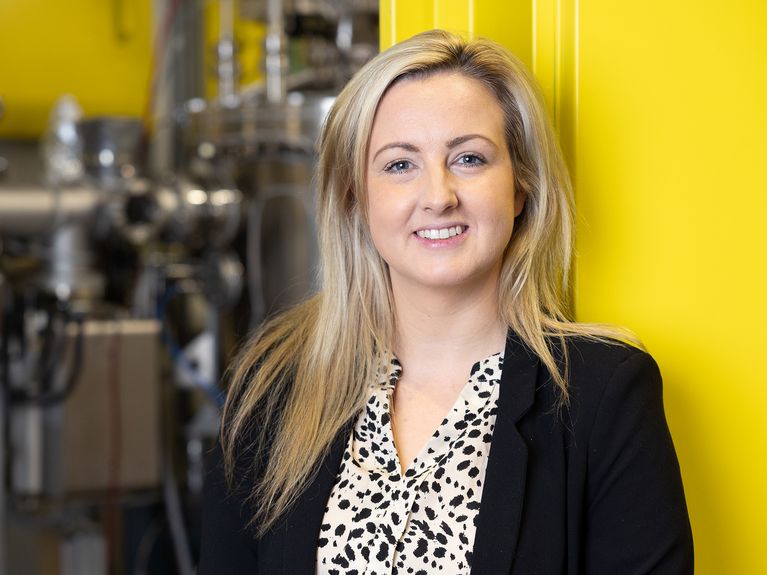
[Translate to English:] Bild: Helmholtz-Zentrum Berlin/Kevin Fuchs
Michelle Browne is an electrochemist, material scientist, and head of the Helmholtz Young Investigator Group Electrocatalysis: Synthesis to Devices at the Helmholtz-Zentrum Berlin für Materialien und Energie (HZB).
What is the most exciting thing about your job?
Growth, in two different senses. The first is seeing the researchers in my team grow in their careers. It’s a great privilege to talk to the PhD students and postdoctoral researchers about their goals and watch them achieve them. If I can help them do so, it’s an added bonus. The second is growth in our research at the HZB, which focuses on developing hydrogen technologies. It’s truly motivating to understand how to make materials optimized for green hydrogen. It is fascinating to see how small changes in the synthesis of materials can alter hydrogen production, like using different protocols to make the same metal oxide or switching the specific type of MXene – a group of highly conductive 2D metal carbide and nitride materials – added to the metal oxide.
If money and time were no object, what would your next project be?
To build a state-of-the-art self-driving lab on the scaling up of materials (metal oxide- and MXene-based of course) for Anion Exchange Membrane (AEM) electrolyzers with the best analytical tools for online characterization. The lab would have a range of AEM electrolyzers with different active areas for scaling, a synthesis platform for making MXenes, and another platform for combining the MXenes with various metal oxides. Another addition would be an area with robotic arms to make membrane electrode assemblies or catalyst-coated membranes.
Who would you like to have dinner with and what would you talk about?
My research teams, both past and present, and all my mentors (some at the HZB, others in Ireland and throughout Europe) to celebrate our achievements and talk about how we can go further together by learning from our mistakes.
First published in our newsletter “Helmholtz Monthly”



Readers comments