Interview
„Technology determines the overall growth potential of society.”
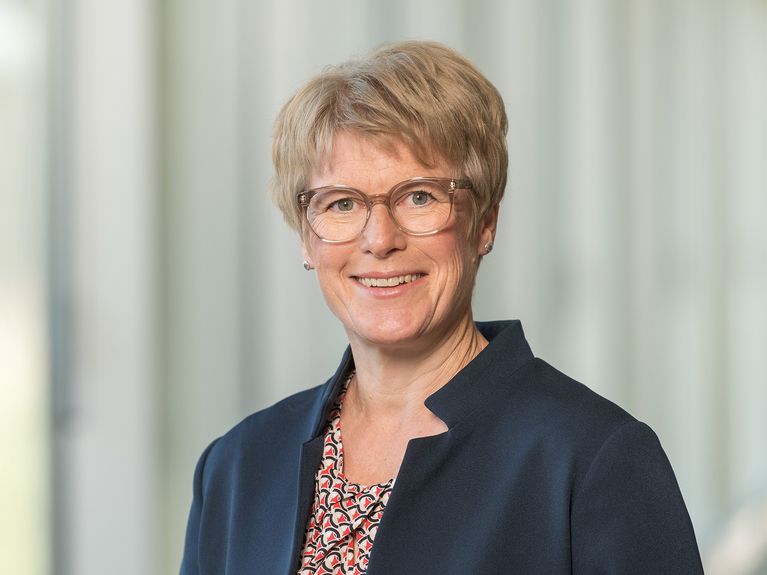
Prof. Veronika Grimm is a professor at the Technical University of Nuremberg (UTN) and heads the Energy Systems and Market Design Lab. Image: Laurin Schmid/Bildkraftwerk
Economist Veronika Grimm is to become a new member of the Senate of the Helmholtz Association. This conversation addresses her perspectives on innovation, the role of research in society, and the areas in which Germany is well-positioned despite its challenges.
Ms. Grimm, as an economist, you work on energy markets and have, among other roles, headed up the Energy Campus Nuremberg. Could it be that you have an engineer’s heart beating inside you?
In the 1990s, I worked part-time as a student assistant at the Schleswig-Holstein Technology Foundation. The focus was on establishing emerging technologies in northern Germany and developing new business models, such as those in sensor technology, medical technology, and digital technologies. I have always been interested in the role of technology—a key factor in the dynamic development of an economy.
You currently lead a working group on energy systems and market design in Nuremberg. To what extent are the natural sciences represented there?
Our team consists of industrial engineers, mathematicians, and economists. We work at the interfaces between these disciplines. For example, we examine the challenges facing the German economy resulting from the ongoing transformation of energy-intensive industries. We also examine the opportunities in the field of new technologies and how this potential can be leveraged.
What overlap do you see between this research and your new role as a member of the Helmholtz Association Senate?
There are significant overlaps in the field of energy-related issues, for example, in energy system and energy market modeling, as well as in analyses of climate-friendly energy sources and renewable energy. There are also links to materials research, as the transformation of industry ultimately depends on the availability of raw materials and their alternatives. There is also a second dimension: I can contribute a macroeconomic perspective to the discussions in the Senate—that is, an understanding of how important technological progress, driven in large part by the Helmholtz Association, is for economic development. Finally, the international perspective is crucial: cross-border cooperation is becoming increasingly important, and Europe, in particular, needs to strengthen and expand its international engagement.
Why?
We are witnessing a technological race between the U.S. and China for global leadership in artificial intelligence. Europe will not be able to isolate itself from these developments. We also observe structural shifts that reshape international value chains. Europe will continue to depend on imports of critical raw materials and energy in the future. We must turn these immense challenges into strengths by significantly expanding and reinforcing our network of international cooperation. Research collaborations play a central role in this: research institutions conduct collaborative research worldwide, exchange knowledge, and constitute a fundamental building block for broader international cooperation. The global Helmholtz research collaborations, which span multiple technological fields, play a central role in this context.
You are a member of the German Council of Economic Experts. How important do you think science is in addressing the current crisis?
It is crucial: without technological progress, maintaining Germany’s competitive position would not be possible.
What does that mean specifically? The German government’s high-tech strategy, for example, repeatedly emphasizes innovation ecosystems in which companies collaborate with research institutions. What role does the Helmholtz Association play in this context?
Germany is well-positioned in these collaborations, and we have clear strengths in this area. The problem lies elsewhere: we are failing to effectively translate ideas into tangible value. Responsibility lies with policymakers here: in Germany, regulation is guided by the precautionary principle.
What does that mean?
First, the risks of technologies are identified, and regulations are implemented to prevent these risks from materializing. Because this occurs while the technologies are still under development, it often hinders the implementation of innovations that create economic value. Consequently, innovation occurs elsewhere, meaning that the regulatory approach itself introduces additional risk.
This is clearly a responsibility for policymakers. Are there areas in which science is also expected to take action?
There are three key points. First, contributing to the resolution of major societal challenges is important. Second, it is essential to attract the most talented scientists. Third, establishing strong collaborative relationships is necessary—with scientific institutions worldwide and within innovation ecosystems that enhance knowledge transfer, innovation, and societal impact. The Helmholtz Senate can play a key role in advancing these initiatives.
Could you elaborate? Are there specific issues you would like to address in the Senate?
I am unable to provide a definitive answer at this stage, as I first need to analyze and understand, which will allow me to gain insight into past developments and the rationale behind previous decisions.
The majority of Senate members have a background in the natural sciences and engineering. Are you concerned that your perspective as an economist will be overlooked?
No, on the contrary. I look forward to the exchange and to integrating the different areas of expertise. Technology determines the growth potential of the economy and the opportunities available to society as a whole. This creates numerous connections between the economic considerations of the ongoing transformation of our economy and the technologies being developed within the Helmholtz Association. The combination of expertise is expected to contribute to the gradual development of a new economic model in Germany. For this reason, I am particularly eager to engage in this interdisciplinary exchange.
About the person:
Veronika Grimm is a professor at the Technical University of Nuremberg (UTN) and serves as head of the Energy Systems and Market Design Lab. Her research focuses on energy markets, energy market modeling, and behavioral economics. She serves as a member of the German Council of Economic Experts, the German Federal Government's National Hydrogen Council, and numerous other committees and advisory boards. As of January, she will join the Senate of the Helmholtz Association.



Readers comments