Interview
„Cooperation is the catalyst for innovation"
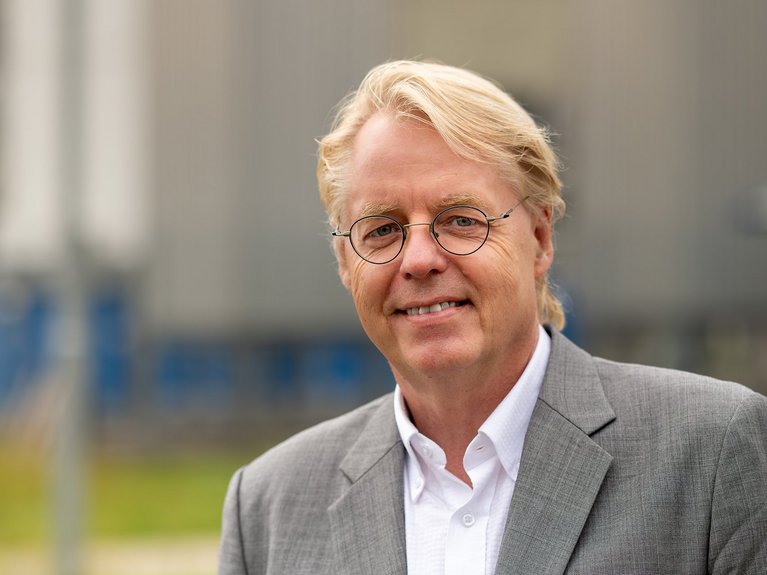
On October 1, 2024, Jan S. Hesthaven took office as President of KIT. Picture: KIT
Jan Hesthaven has been Vice President of the Helmholtz Association's Energy Research Field since 1 January 2026. In this interview, he discusses the importance of expanding strategic alliances and effective communication for the successful implementation of the energy transition.
You have gained extensive management experience at renowned universities in the USA and Switzerland. You have now been president of the Karlsruhe Institute of Technology (KIT) for approximately one year. Which experiences from your career to date would you particularly like to bring to your work at Helmholtz Energy?
For me, it is of central importance that research has an impact in teaching, society, the economy and politics. During my time abroad, which has spanned almost 30 years, I have learned that we can only achieve this through strong and comprehensive interdisciplinary cooperation. This is the catalyst for innovation and technology transfer. As an applied mathematician, I particularly value this approach. I am convinced that solutions to complex problems can only be found through cooperation and exchange.
Last year, you developed a vision for the Karlsruhe Institute of Technology (KIT) based on the motto 'Science for Impact'. How would you like to implement this guiding principle in your new role as Helmholtz Vice President for Energy, and how would you like to integrate it into the culture of Helmholtz Energy?
To me, 'Science for Impact' means focusing consistently on the social benefits of our research and teaching above all else. At the same time, we must not forget that basic research is the foundation for tomorrow's innovations and solutions. Curiosity-driven research must be strongly supported. As Helmholtz Vice President of Energy, I have three key priorities: Firstly, our research should address major challenges such as the energy transition, climate protection and new materials. Second, I would like to contribute my experience in strategic orientation and international networking to find ways to translate research results into practice more quickly and further strengthen interdisciplinary cooperation.
Secondly, research must facilitate the development of marketable solutions. By working closely with the executive boards, I aim to raise the profile of Helmholtz Energy as a leading partner in practical energy research, while also positioning our researchers as innovators and technology transfer leaders.
Thirdly, international networking is crucial for conducting cutting-edge research and remaining competitive in international markets, and I would like to mention this. Drawing on my experience of building international networks, I will work with the Management Board to strengthen Helmholtz Energy Research's position as a reliable international research and industry partner, and ensure our work receives the recognition it deserves.
The German government's High-Tech Agenda focuses on technology transfer and strengthening cooperation between research and industry within the framework of Germany as a location for innovation. How do you intend to promote this cooperation in concrete terms?
Helmholtz Energy already works closely with industry, but we need to expand this cooperation further. A key element here is our unique selling points: the large-scale infrastructure and real-world laboratories within Helmholtz, and our support for long-term, mission-oriented research and development. I would like to give two examples here:
In the 'Energy Lab' model laboratory, scientists from the Karlsruhe Institute of Technology (KIT), the Forschungszentrum Jülich (FZJ) and the German Aerospace Center (DLR) are researching the energy system of the future in close collaboration with industry. Another example is the BESSY synchrotron at the Helmholtz Centre Berlin, where scientists from several centres collaborate with industry to develop innovative materials for solar cells and batteries, among other things.
The close integration of excellent research, unique infrastructure and industrial applications is one of the great strengths of Helmholtz Energy, offering considerable potential for further expansion.
Germany's High-Tech Agenda also emphasises the importance of cooperation between politics and science. How relevant is this task to you, and what steps are you taking to ensure that research results are incorporated into political decisions, and that energy research remains a visible part of the political agenda?
In view of the complex challenges of our time, from climate change to the energy transition and geopolitical security, communication with political decision-makers is becoming increasingly important. Clear and fact-based communication is essential to ensure that political decisions are based on scientific evidence. Transparency is equally important because it fosters trust in science and politics, and combats disinformation with facts. Last but not least, we are responsible for effectively incorporating research results into social transformation — after all, our work is financed by public funds. Helmholtz Energy is already working intensively in this area, effectively incorporating scientific findings into policy and raising the profile of energy research expertise. Modern science and technology are so complex that politicians often find it difficult to understand the details before making important decisions. We must therefore position ourselves as a source of trustworthy knowledge and expertise in key technologies.
What major challenges do you foresee for the Helmholtz Energy Research Field in the coming years, and how would you prepare it for these challenges?
Our research must deliver concrete solutions for climate neutrality and security of supply. We aim to accelerate decarbonisation and the energy transition, thereby increasing energy sovereignty and securing Germany's position as a business location. At the same time, the rapid development of artificial intelligence is opening up new opportunities for more efficient and cost-effective energy systems. However, these opportunities present challenges in terms of transparency, explainability and robustness. It would be unwise to ignore this new development. Caution is therefore advised, particularly with regard to critical infrastructures. Another focus remains on technology transfer: research results should be incorporated into industrial applications more quickly through pilot projects, partnerships and innovation platforms. At the same time, we must strengthen our international competitiveness, attract talent, and expand global cooperation to establish Helmholtz Energy as a leading player and increase our visibility.
To achieve these goals, the executive boards should collaborate with policymakers to expand our reliable basic funding and secure third-party funding, enabling strategic investments in key technologies such as hydrogen, storage, grid integration, and resilience.



Readers comments