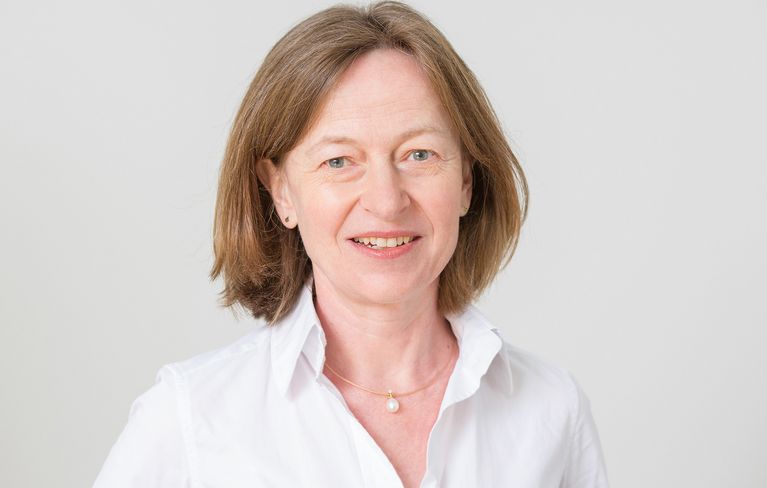
Judith Katzy
Judith Katzy researches elementary particle physics, with a particular focus on the Higgs boson, using machine learning techniques.
Particle physics
Higgs physics and cosmology
Machine learning
Judith Katzy leads the research group on the elementary particles Higgs boson and top quark at the Deutsches Elektronen-Synchrotron (DESY).
Machine learning is essential to her work: Katzy conducts research within the ATLAS experiment at the Large Hadron Collider (LHC), located at the European Organization for Nuclear Research (CERN) in Geneva. The ATLAS experiment produces more than 100 terabytes of data per day. Machine learning provides the key tools that enable scientific discoveries from these vast datasets.
At the LHC, protons collide at nearly the speed of light, creating particles such as the Higgs boson. These particles are recorded and analyzed by the ATLAS detector. Katzy investigates the interactions between Higgs bosons and quarks, in particular with the top quark, the heaviest known elementary particle. These interactions played a significant role in the early evolution of the universe: the Big Bang created equal amounts of matter and antimatter, yet today, antimatter is barely observed. This matter-antimatter asymmetry could have arisen from interactions between top quarks and the Higgs boson.
Judith Katzy studied physics at Heidelberg University, where she also earned her doctorate, and obtained her habilitation at Humboldt-Universität of Berlin. She worked as a postdoctoral researcher at the Massachusetts Institute of Technology (MIT) in Boston and at the University of Illinois at Chicago. Katzy has been conducting research at DESY since 2001, including extended research stays at CERN, and is involved in numerous research projects at the ATLAS experiment and in machine learning research. She is also a private lecturer at Humboldt-Universität of Berlin (HU Berlin).
