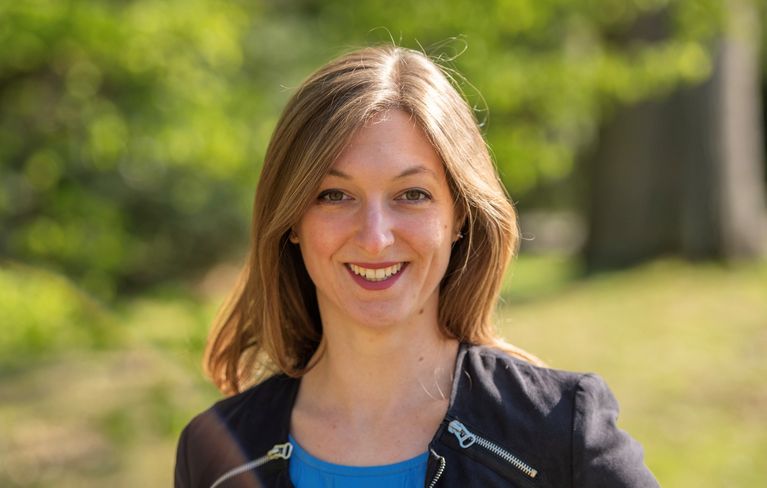
Charlotte Debus
Charlotte Debus develops scalable methods that not only help AI models work more efficiently but also provide information about the degree of uncertainty in their statements.
Robustness and efficiency of AI applications
High-performance computing
Sustainability in AI research
Charlotte Debus conducts research at the Scientific Computing Center (SCC) at the Karlsruhe Institute of Technology (KIT) and develops AI methods for scientific applications. She is particularly interested in how machine learning can be made more robust and efficient so that these methods can also be used in complex and critical areas, such as weather forecasting, energy systems, and medical diagnostics. The models should also provide information about the degree of uncertainty in their predictions.
Since many of these applications involve extremely large amounts of data, high-performance computing (HPC) plays a central role in Debus’ research: Together with her team, the physicist develops scalable AI methods using distributed computing approaches specifically optimized for modern supercomputers.
The sustainability of AI research is particularly important to Debus: machine learning and AI methods consume large amounts of energy. That is why Debus and her team are developing algorithms that make maximum efficient use of the computing resources employed.
Debus studied physics at Heidelberg University, where she also earned her doctorate. After working at the German Cancer Research Center and the German Aerospace Center, she has been conducting research at KIT since 2020. Since 2022, she has been leading the junior research group “Robust and Efficient Artificial Intelligence” there.
