Impact Story #12
Quality Control on a Chip
Tiny chemical signals reveal the freshness of olive oil and help verify proper beer storage. A sensor developed by Helmholtz researchers enables the detection of these signals for the first time through a mobile, cost-effective approach.
When food ages or spoils, it often produces so-called free radicals—highly reactive molecules that cause chemical changes. Their detection is a reliable indicator of declining food quality. Until now, measuring food quality has usually required complex laboratory technology.
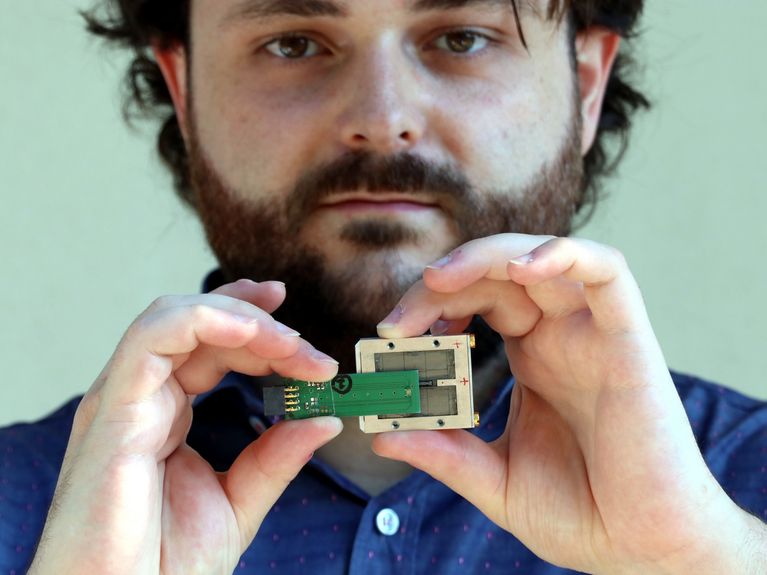
Researchers at Helmholtz-Zentrum Berlin (HZB) have developed a compact solution to address this challenge. They adapted a method from basic research—electron spin resonance (EPR)—to create a portable chip-based sensor system. EPR enables the highly sensitive detection of free radicals. Until now, however, the method has typically required large and expensive equipment.
A new sensor enables this analysis on a mobile platform for the first time. The sensor detects even low concentrations of free radicals and can be integrated directly into production processes. Initial applications focus on quality control for olive oil and beer, enabling the early detection of compositional changes.
This research gave rise to the SpinMagIC initiative, including a spin-off company dedicated to further developing and commercializing the sensors. Numerous additional applications are conceivable, including medical diagnostics, drug development, and battery research.
In summary, advances arising from basic research in electron spin resonance could enable faster, more cost-effective verification of food quality and support numerous additional applications.
Image: Luca Segantini