Helmholtz Association

Helmholtz Association of German Research Centres

The Helmholtz Association contributes to solving major challenges facing society, science and industry with top scientific achievements in six research areas: Energy, Earth and Environment, Health, Key Technologies, Structure of Matter, Transport and Space. With 28,000 employees in 16 research centres and an annual budget of approximately 2.8 billion euros, the Helmholtz Association is Germany’s largest scientific organisation. Its work follows in the tradition of the great natural scientist Hermann von Helmholtz (1821-1894).

08.03.10

Wendelstein 7-X - installation with certified quality management

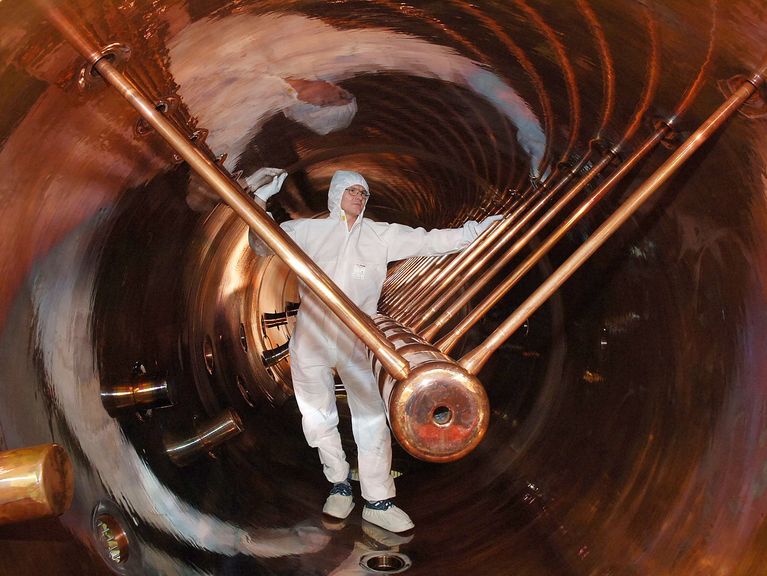
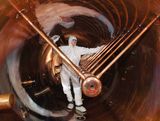
Spulen Wendelstein7X Kemnitz IPP 100x66The system of quality management governing construction of the Wendelstein 7-X fusion device has now been certified in accordance with the DIN ISO 9001 German industrial standard. The auditors of the TÜV Nord inspectorate thereby confirm that the research device being built at the Greifswald branch of Max Planck Institute of Plasma Physics (IPP) conforms to industrial standards – as one of the first in Germany.

Wendelstein 7-X - installation with certified quality management

25.02.10

Online now: the Regional Climate Atlas for Germany

regionaler klimaatlas helmholtz 100x66The Helmholtz Association’s network of Regional Climate Offices has produced a regional climate atlas for Germany showing the possible effects of climate change at the regional level. The climate scenarios for Germany’s federal states are now available to the public for online reference.

Online now: the Regional Climate Atlas for Germany

11.02.10

On the trail of space weather: SDO solar observatory launched successfully

Magnetfeldlinien Sonne NASA 100x66Beginning Thursday, 11 February 2010, our Sun is being monitored round the clock - the space-based Solar Dynamics Observatory (SDO) was launched successfully from Cape Canaveral on an Atlas V. The continuous stream of data supplied by this observatory will substantially improve our ability to forecast space weather. The German Aerospace Center (DLR) is supporting this NASA-led mission with the SDO Data Center at the Max-Planck-Institute for Solar System Research (MPS).

On the trail of space weather: SDO solar observatory launched successfully

11.02.10

He Who Dares Wins – Million Euro Funding for DKFZ Researcher

Prof Christof Niehrs Foto Yan de Andres 100x66The European Research Council will provide funding of 2.4 million euro over the next four years to support a research project of Christof Niehrs at the German Cancer Research Center (Deutsches Krebsforschungszentrum, DKFZ). Niehrs investigates the processes of reactivation of silenced genes in cells. Disruption of this mechanism can cause cancer and other diseases.

He Who Dares Wins – Million Euro Funding for DKFZ Researcher

Research

Concentrated competence

The Helmholtz Association contributes to unravelling complex systems which determine human life and environment. The Association develops answers to the decisive questions which move people today and in the future.

To Helmholtz research

News

Overview of latest news

Look here to find the latest news about the Helmholtz Association and its 16 Research Centres, access press releases or information on upcoming events or the latest newsletter, publications, speeches or podcasts.

To latest news

About us

Organisation and structure

Information about our mission and profile, strategy and programme-oriented funding system, as well as the organisation and the central bodies of the Helmholtz Association.

To 'About us'

Job and Career Opportunities

Take your chance

At a glance: Vacancies in the 16 Research Centres and in the Helmholtz Head Office, PhD and diploma theses, work placement and vocational training.

To Job & Career opportunities

Pact for Research and Innovation

Shaping the Research Area

The Helmholtz Association is partner in the innovation campaign initiated by Germany's federal and state governments.

To Pact for Research and Innovation

Printversion of this page
PDF-Version of this page
15.03.2010