Research Field Earth and Environment
Understanding System Earth to ensure that our home planet remains ecologically stable and the climate equilibrium is not knocked out of balance. Helmholtz researchers search for sustainable solutions for the co-existence of industrial society and the natural environment.
Goals and Roles
Humans influence their environment to a significant extent: Climate change, species decline and extinction and other critical developments have been observed for decades, and important resources, such as drinking water or fertile soils threaten to become scarce.
- Zoom

- .
- Lena River Delta - Landsat 2000 05, Image: Alfred-Wegener-Institut
This is why the Helmholtz Association is engaged in preventive research. The research regarding Earth and Environment studies the fundamental functions of the system earth and the interactions between society and nature, thereby creating a sound knowledge base for securing the long-term foundations of human life. This is about understanding the complex changes of Earth and Environment in detail and to develop future scenarios so that decision-makers in politics and society are given sound scientific recommendations for their actions.
The diversity of questions calls for the effective use of the scientific infrastructure and new kinds of strategic research networks within and beyond the Helmholtz Association. Expertise and resources are pooled through national and international collaboration with universities and extramural research institutions, for example in virtual institutes and also in increased collaboration and cooperation activities at a European level. The 18 current Helmholtz Virtual Institutes demonstrate the excellent links and connections between the individual centres and university partners. In addition, the research field also contributes to two Excellence Clusters: “The Ocean in the Earth System” (University Bremen/AWI), “Integrated Climate System Analysis and Prediction” (University Hamburg/HZG) and a Graduate School “Global Change in the Marine Realm” (University Bremen/AWI) from the federal government’s excellence competition, which underlines the first-rate cooperation with university partners outside the Helmholtz Association.
The Climate Initiative “Regional Climate Changes” (REKLIM) constitutes a new research alliance. It pools the expertise and competencies of various Helmholtz Centres in close collaboration with universities and non-university research groups in order to study and explore the regional impact of global climate change. Socioeconomic aspects are also taken into account to draw up concrete recommendations on the sustainable cultivation of forests and agricultural areas as well as on efficient water management. Furthermore, the Climate Initiative works closely together with the regional Helmholtz Climate Offices (Southern, Central, and Northern Germany, Polar Regions and Sea Level Rise), and the newly founded Climate Service Centre as a communication platform for climate-relevant questions. A further initiative featuring strong involvement of university partners is represented in the “Water Science Alliance”, which strategically focuses the competencies in hydrological research. Cross-centre and cross-institutional research projects at international level are playing an ever more important role in the Helmholtz Association. The Helmholtz Association of German Research Centres and the University of Alberta, Canada intend to cooperate more closely in particular in the research fields Energy and Earth and Environment. For this purpose, the President of the Helmholtz Association, Prof. Dr. Jürgen Mlynek, and the President of the University of Alberta, Prof. Dr. Indira Samarasekera, signed a corresponding “Memorandum of Understanding” in the presence of government representatives on 29 September 2009. The cooperation projected for the next years covers research topics such as the environmentally friendly use of oil sands, the separation and geological storage of CO2 (CCS), geothermal energy, the reclamation of water bodies and land as well as recultivation and landscaping. Apart from the Helmholtz Centre Potsdam – GFZ German Research Centre for Geosciences, initially three more Helmholtz Centres contribute their expertise: the Karlsruhe Institute of Technology, the Helmholtz Centre for Environmental Research – UFZ and the Forschungszentrum Jülich.
Another task for the Research Field is the promotion of young scientists and researchers. The existing measures and structures are continually developed, in most cases in cooperation with external partners. In the field of education and training, these are the Graduate Schools and Helmholtz Research Schools, in the field of independent, autonomous research the Young Investigators Groups. Currently, two Graduate Schools are sponsored within the research field Earth and Environment (“Helmholtz Interdisciplinary Graduate School for Environmental Research” at the UFZ with six university partners and the “Helmholtz-Graduate School for Polar and Marine Research” at the AWI with three university partners) in addition to the “Helmholtz Research School on Earth System Science” (AWI with two university partners). The number of supervised doctoral candidates reached a record high with 841 in 2009. Furthermore, 15 Helmholtz Young Investigators Groups with reference to the research field are currently being funded.
The Geosystem Programme: The Changing Earth
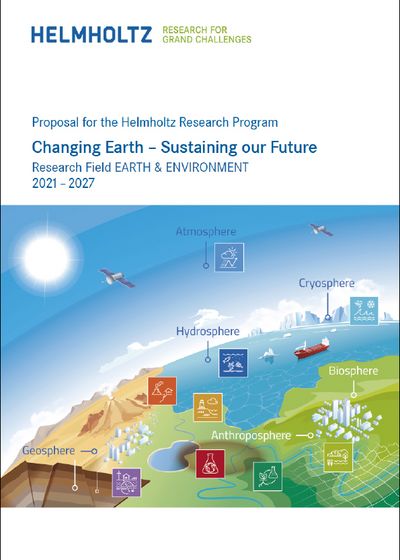
The analysis of the physical and chemical processes within the earth’s systems and interaction between geosphere, atmosphere, hydrosphere, pedosphere and biosphere and their impact on the human habitat lie at the heart of this programme.
More details about Research Programme Geosystem: The Changing Earth
Marine, Coastal and Polar Systems Programme
The research programme has taken on the task of observing contemporary changes in the oceans, polar systems and coastal regions and in particular their assessment against the background of past changes.
More details about Research Programme Marine, Coastal and Polar Systems
Atmosphere and Climate Programme
The research programme addresses the role played by the atmosphere within the climate system as well as those processes that have a decisive influence on climate changes, natural disasters, air quality and hence quality of life on Earth.
More details about Research Programme Atmosphere and Climate
Terrestrial Environment Programme
The Terrestrial Environment Programme aims to preserve the foundations of human life and develop options for the sustainable use of resources.
More details about Research Programme Terrestrial Environment
The programmes in the funding period 2009-2013
To address superordinate research topics and to create methodological and organisational synergies, additional cross-cut initiatives such as “Climate” (AWI, Forschungszentrum Jülich, KIT, GFZ, HZG, Helmholtz Zentrum München, UFZ), “Integrated Earth Observation System” (Network EOS: AWI, DLR, GFZ, HZG, Forschungszentrum Jülich, KIT) and “Sustainable Bioeconomy” (Forschungszentrum Jülich, GFZ, Helmholtz Zentrum München, KIT, UFZ) are further developed. A further key element is the joint creation and operation of cross-programme infrastructures, such as the research aircraft HALO or the “Terrestrial Environmental Observatories” (TERENO).
For instance, the latter will establish up to four selected terrestrial observatories in regions that are representative of Germany by 2010, thereby creating a TERENO Network on the basis of existing research stations and long-term data series. A comparableapproach is pursued with the Observation System COSYNA, with a long-term observation system being built up initially for the German North Sea and later also for Arctic coastal waters in order to enable a synoptic description of conditions.
The Geosystem Programme: The Changing Earth
The analysis of the physical and chemical processes within the earth’s systems and interaction between geosphere, atmosphere, hydrosphere, pedosphere and biosphere and their impact on the human habitat lie at the heart of this programme.
More details about Research Programme Geosystem: The Changing Earth
Marine, Coastal and Polar Systems Programme
The research programme has taken on the task of observing contemporary changes in the oceans, polar systems and coastal regions and in particular their assessment against the background of past changes.
More details about Research Programme Marine, Coastal and Polar Systems
Atmosphere and Climate Programme
The research programme addresses the role played by the atmosphere within the climate system as well as those processes that have a decisive influence on climate changes, natural disasters, air quality and hence quality of life on Earth.
More details about Research Programme Atmosphere and Climate
Terrestrial Environment Programme
The Terrestrial Environment Programme aims to preserve the foundations of human life and develop options for the sustainable use of resources.
More details about Research Programme Terrestrial Environment
Involved Helmholtz Centres
Alfred Wegener Institute for Polar and Marine Research
GEOMAR Helmholtz Centre for Ocean Research Kiel
Karlsruhe Institute of Technology
Helmholtz Centre Potsdam, GFZ German Research Centre for Geosciences
Helmholtz Zentrum München - German Research Centre for Environmental Health
Insights into Research Field Earth and Environment
The Helmholtz Association aims to use ground-breaking research to tackle the great questions of our time. Here, we present projects currently being carried out by scientists at the Helmholtz Centres. The examples range from fundamental questions concerning the origin of matter to health research and the development of high performance functional materials.
Contact
Prof. Dr. Reinhard F. J. Hüttl
Research Field Coordinator Earth and Environment
Helmholtz Centre Potsdam - GFZ German Research Centre for Geosciences
Telegrafenberg
14473 Potsdam
+49 331 288-1010
+49 331 288-1002
reinhard.huettl(at)gfz-potsdam.de
http://www.gfz-potsdam.de
Dr. Cathrin Brüchmann
Research Field Earth and Environment
Helmholtz Association
+49 30 206329-45
cathrin.bruechmann (at) helmholtz.de